This is the sportiest version in the Multistrada line, created for those who want to get the most out of their trip without sacrificing comfort. Next, I'll break down how Ducati managed to combine this wild temperament with technologies that turn your ride into a pleasure.
Contents
- Design
- Chassis and Handling
- Electronics and Safety
- Engine and Transmission
- Fule Consuption
- Ride Experience
- Pricing
- Competitors
- FAQ
DESIGN
Front end
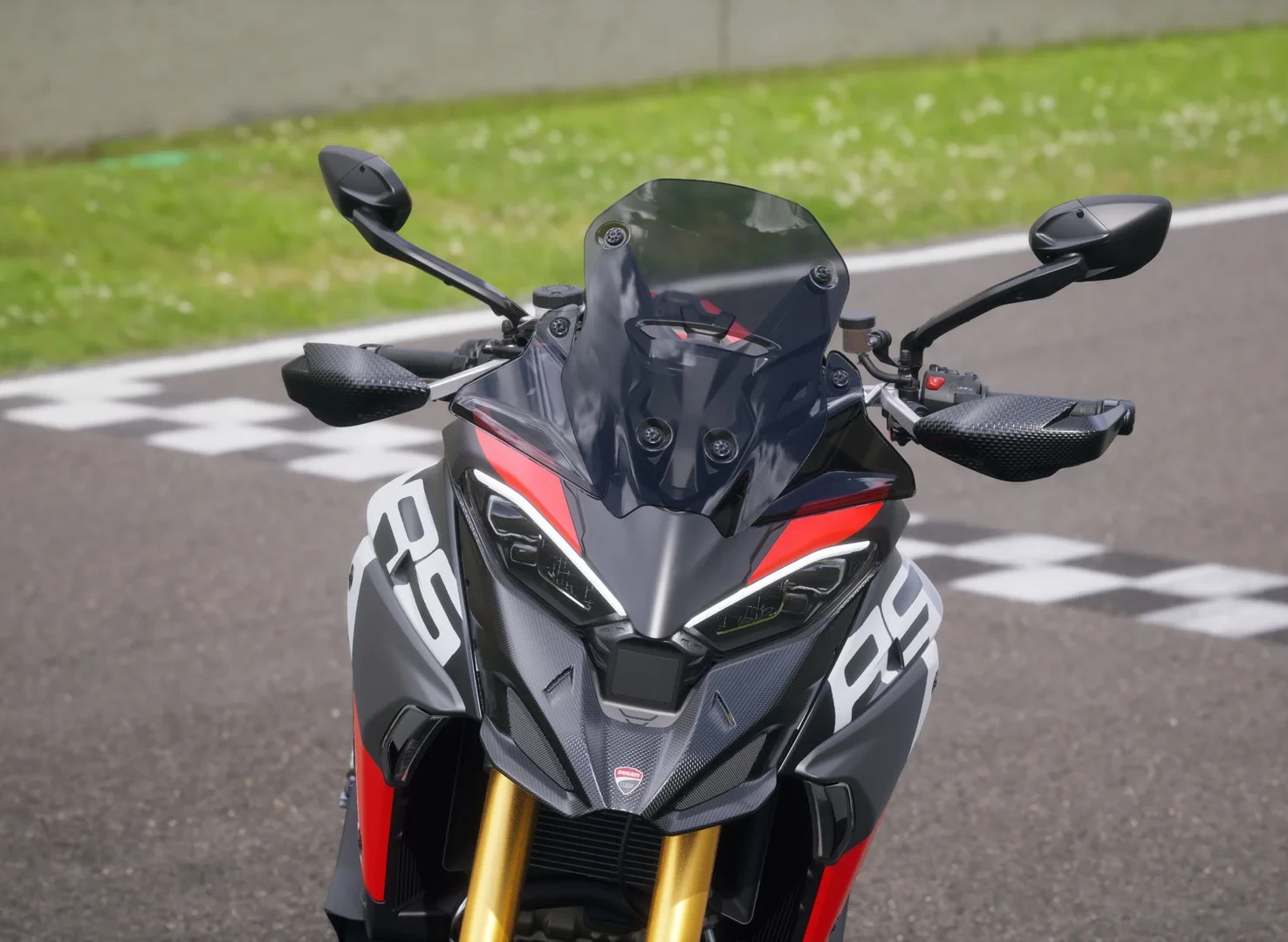
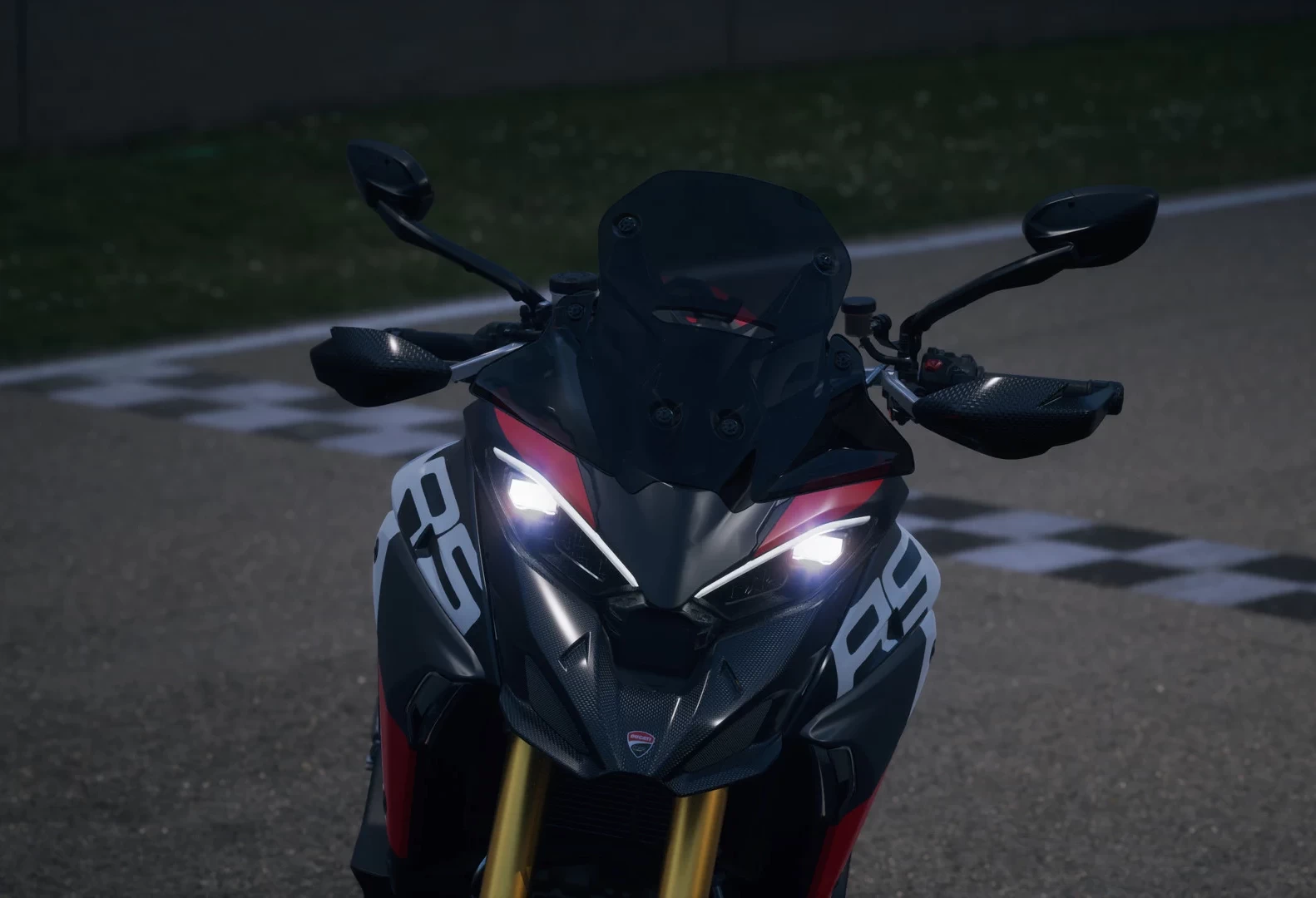
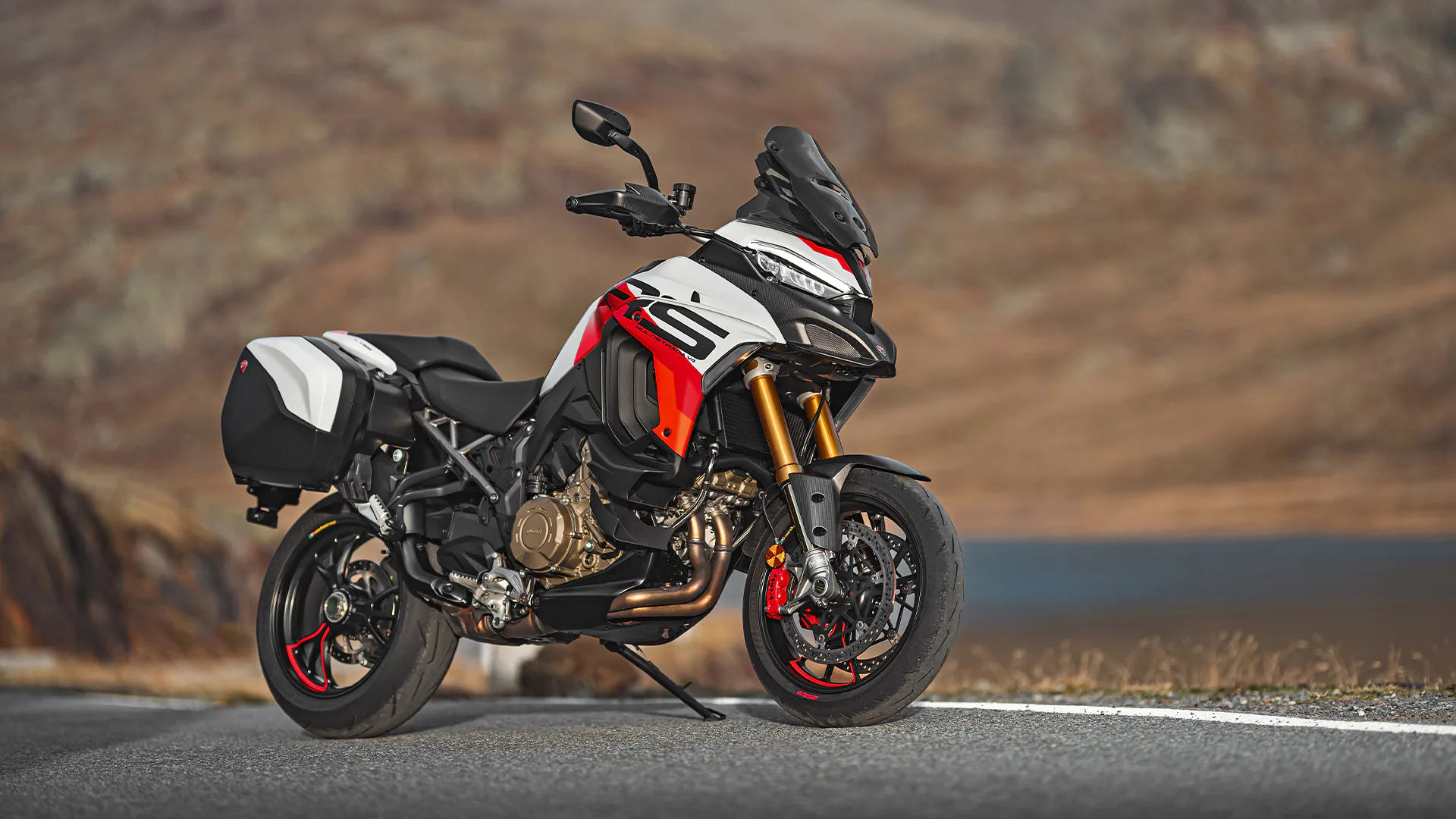
At first glance, the front end of the Multistrada V4 RS shows its Ducati heritage: narrow LED headlights create an aggressive ‘look’, while the sharp ‘beak’ combines aerodynamics and visual dynamics. The windscreen is not just a decorative element — it acts as an active aerodynamic tool, deflecting airflow during high-speed riding. The central part of the fairing integrates the adaptive cruise control radar, whose compact size fits perfectly into the design without compromising the integrity of the lines.
Technical geometry plays a key role here: the 25.7° fork angle and 120 mm trail create a sharp, almost ‘sporty’ front profile. This not only gives a visual sense of aggression, but also emphasises the ease of handling — the front end looks as if it is ready to respond instantly to the slightest movement of the handlebars.
Side view
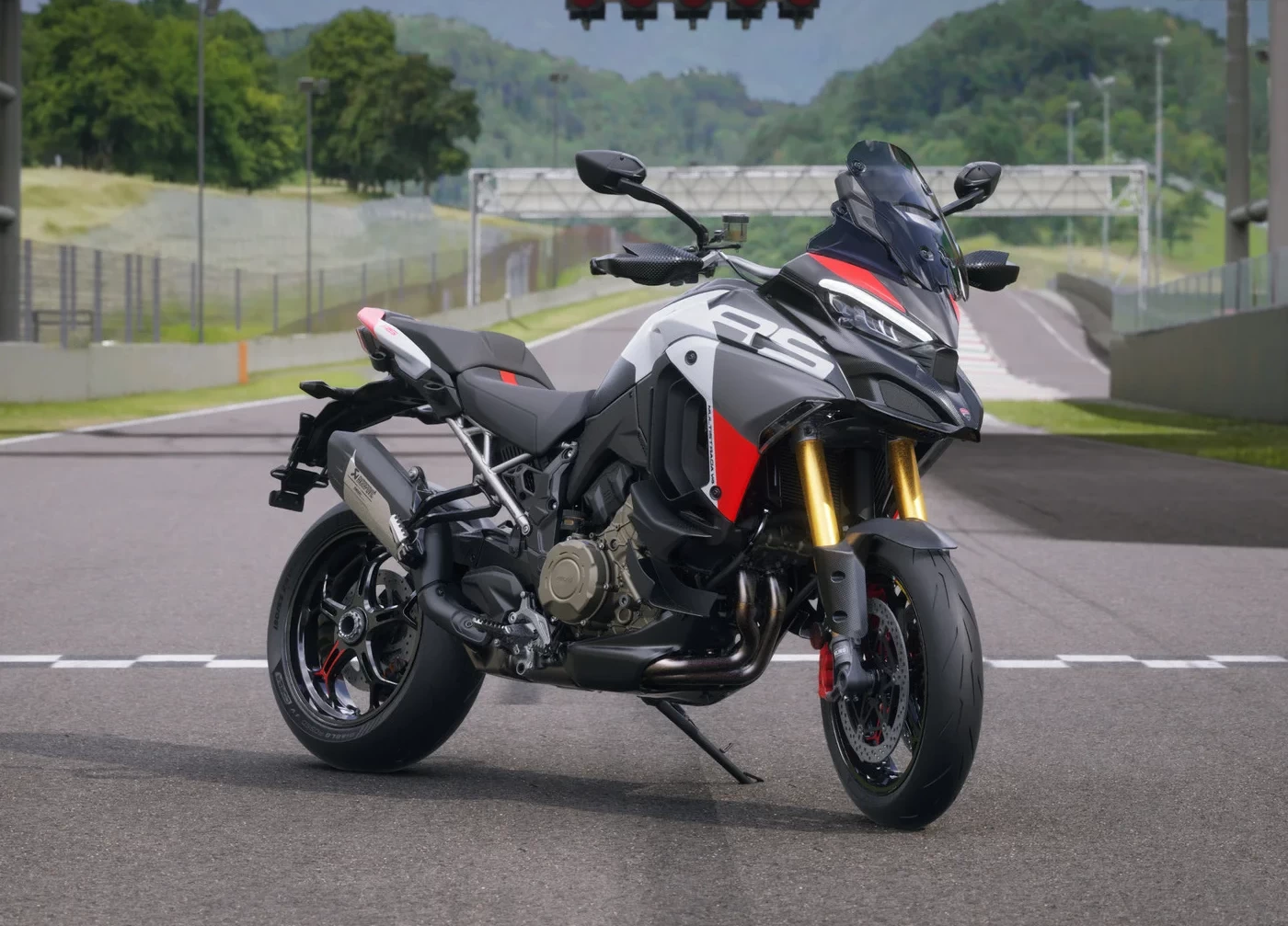
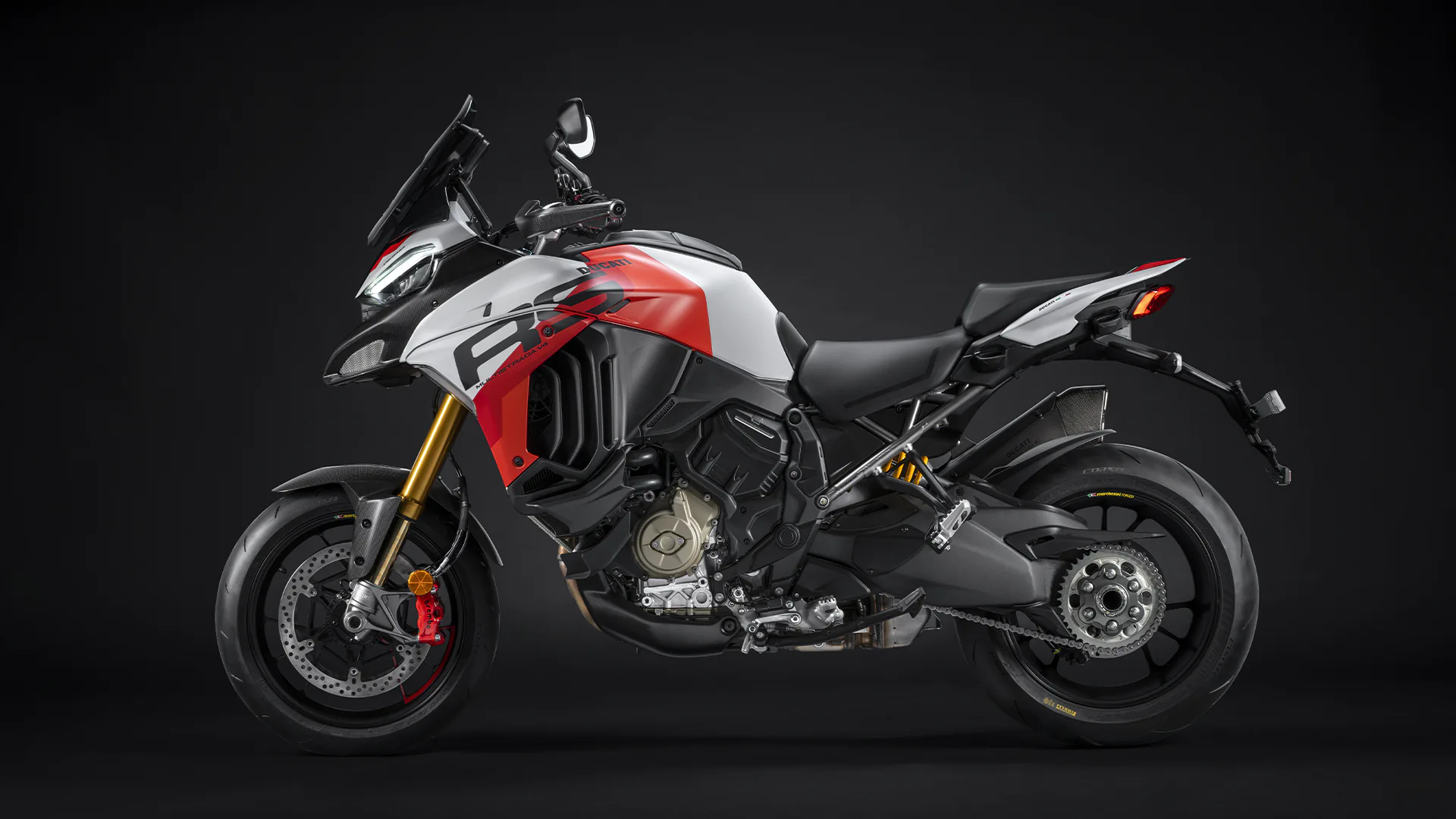
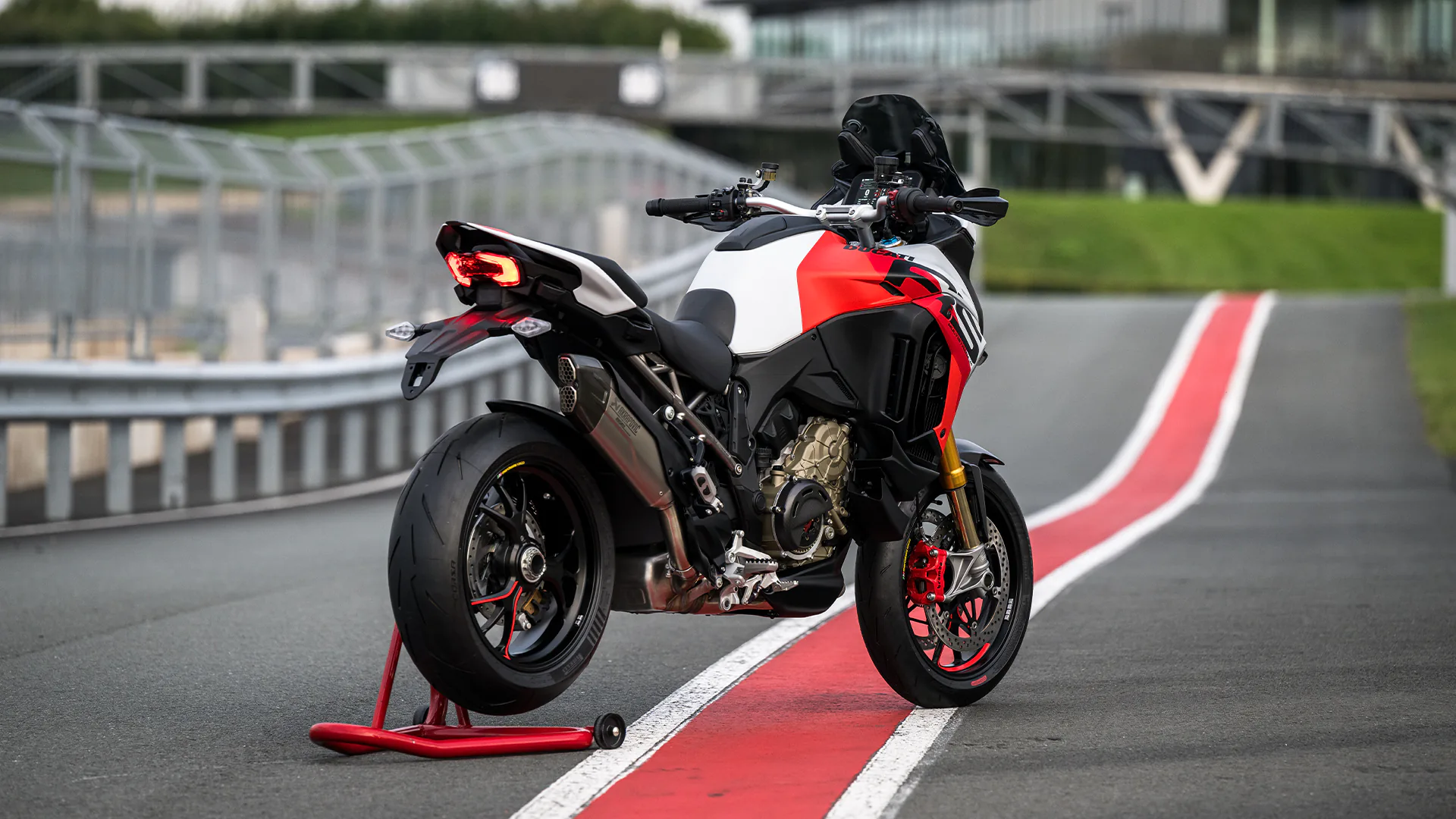
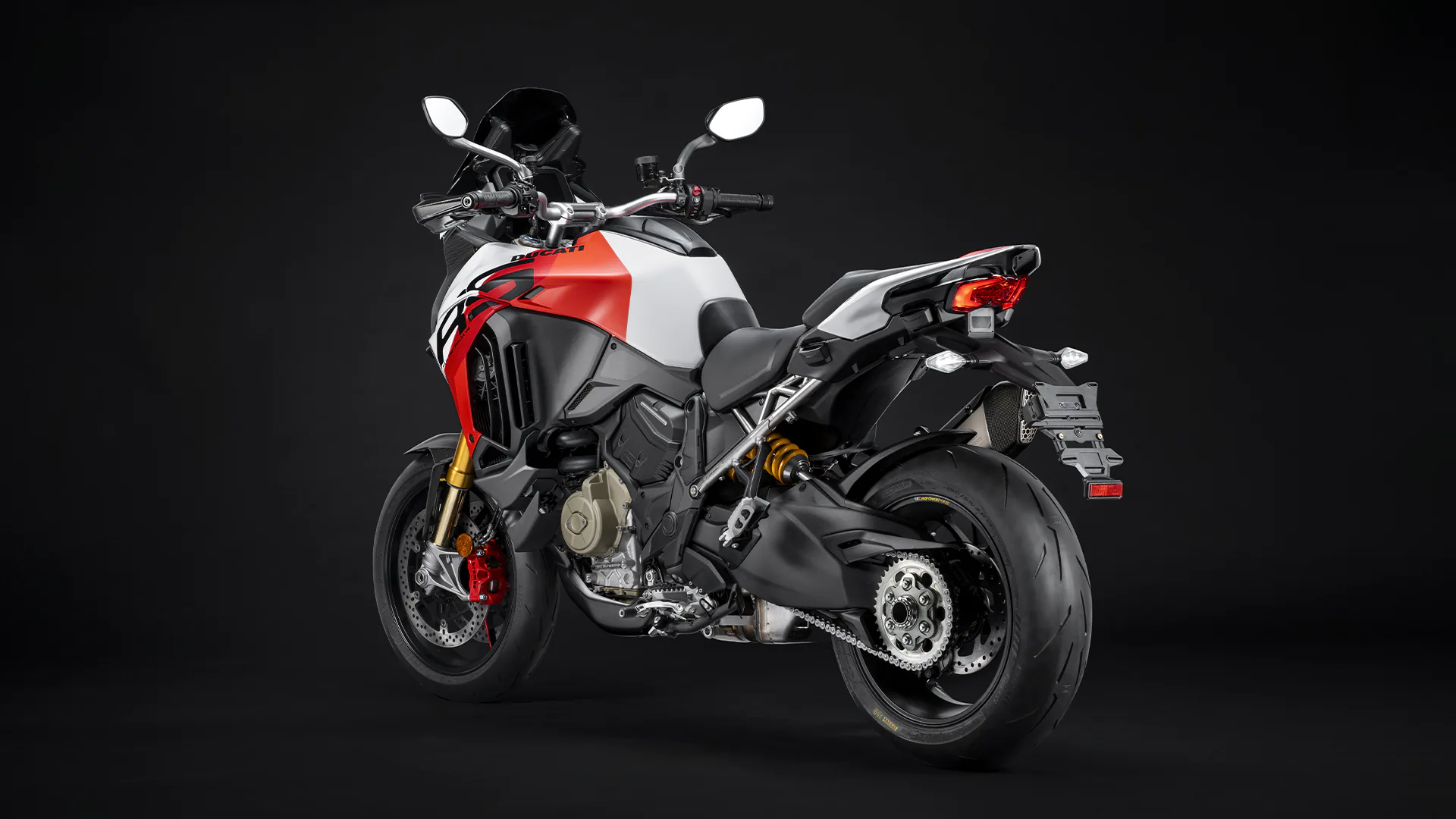
In profile, the Multistrada V4 RS looks sleek and muscular, just as a tourist bike should. The 1,591 mm wheelbase provides a balance between stability at high speeds and manoeuvrability in heavy traffic or on narrow trails. The silhouette of the RS is visually ‘stretched’ forward, reminiscent of Ducati sports bikes, but with the added bulk of the fuel tank.
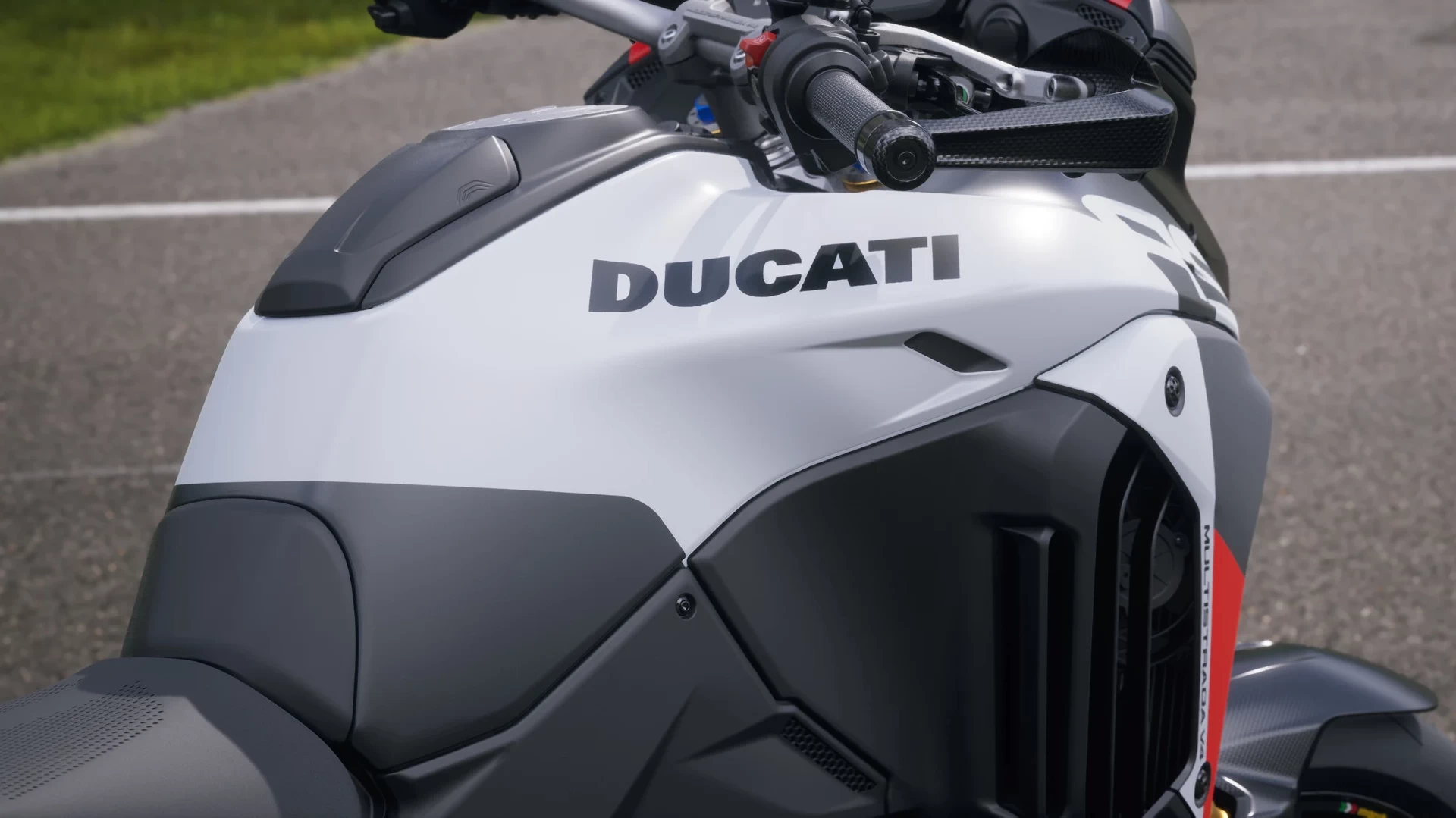
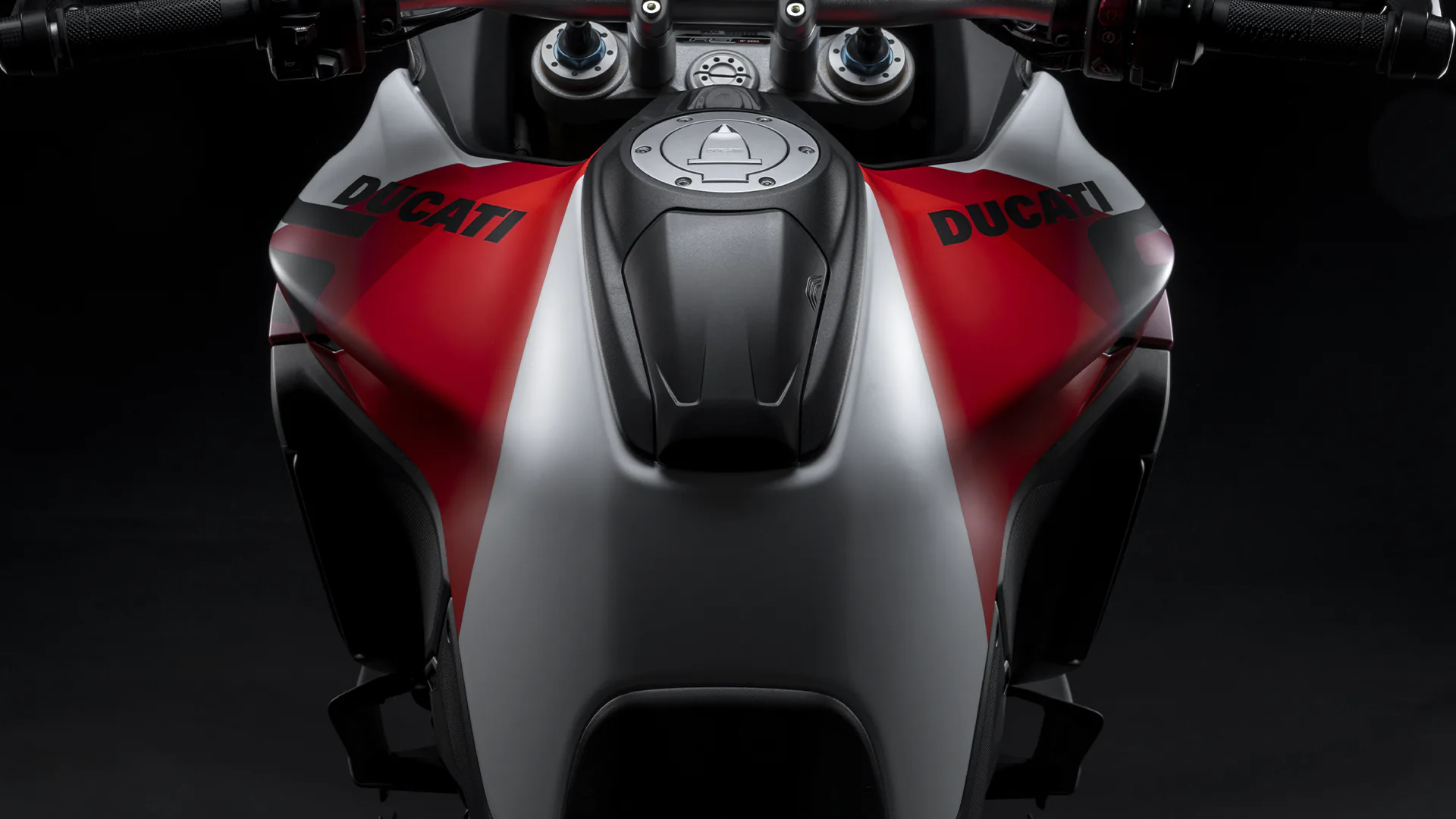
The 22-litre tank is not only practical, but its shape is also integrated into the ergonomics. The carved edges allow the rider to securely grip the tank with their knees, as if they were a piece of a construction set that fits perfectly with the rest. At the same time, even with a full tank, the dry weight of 225 kg without fuel will not give a feeling of imbalance.
Special attention in the RS is paid to carbon elements: wings, fairing panels and carbon fibre inserts visually accentuate the side silhouette. They are not only for aesthetics — the use of carbon reduces weight, improving mass balance, which is critical for a motorcycle with over 180 hp. The central focus is the V4 Desmosedici Stradale engine, which occupies its niche in the frame like a sculpture by an Italian sculptor.
Rear
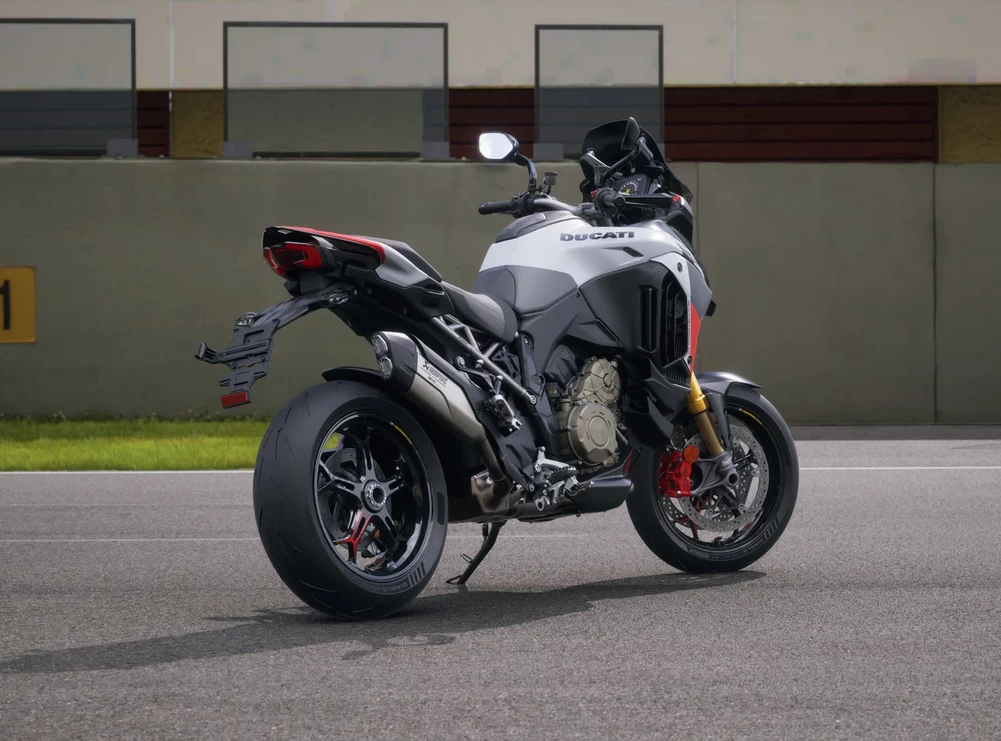
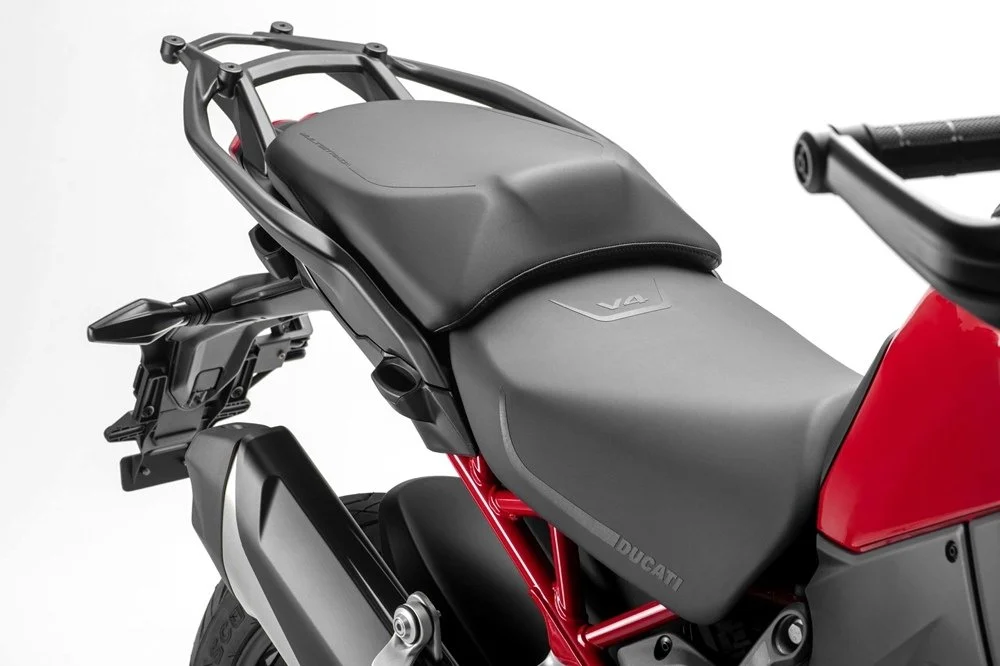
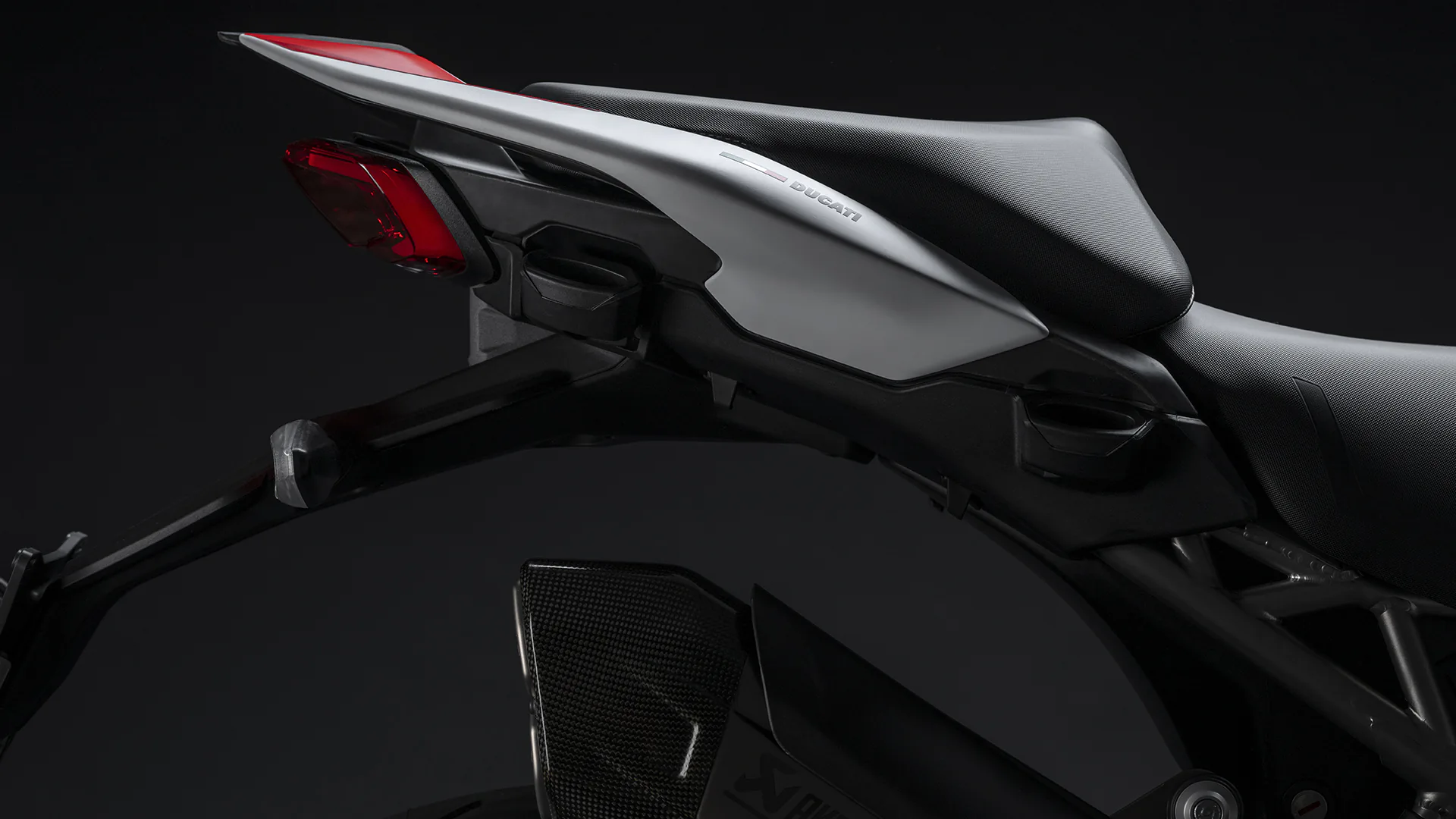
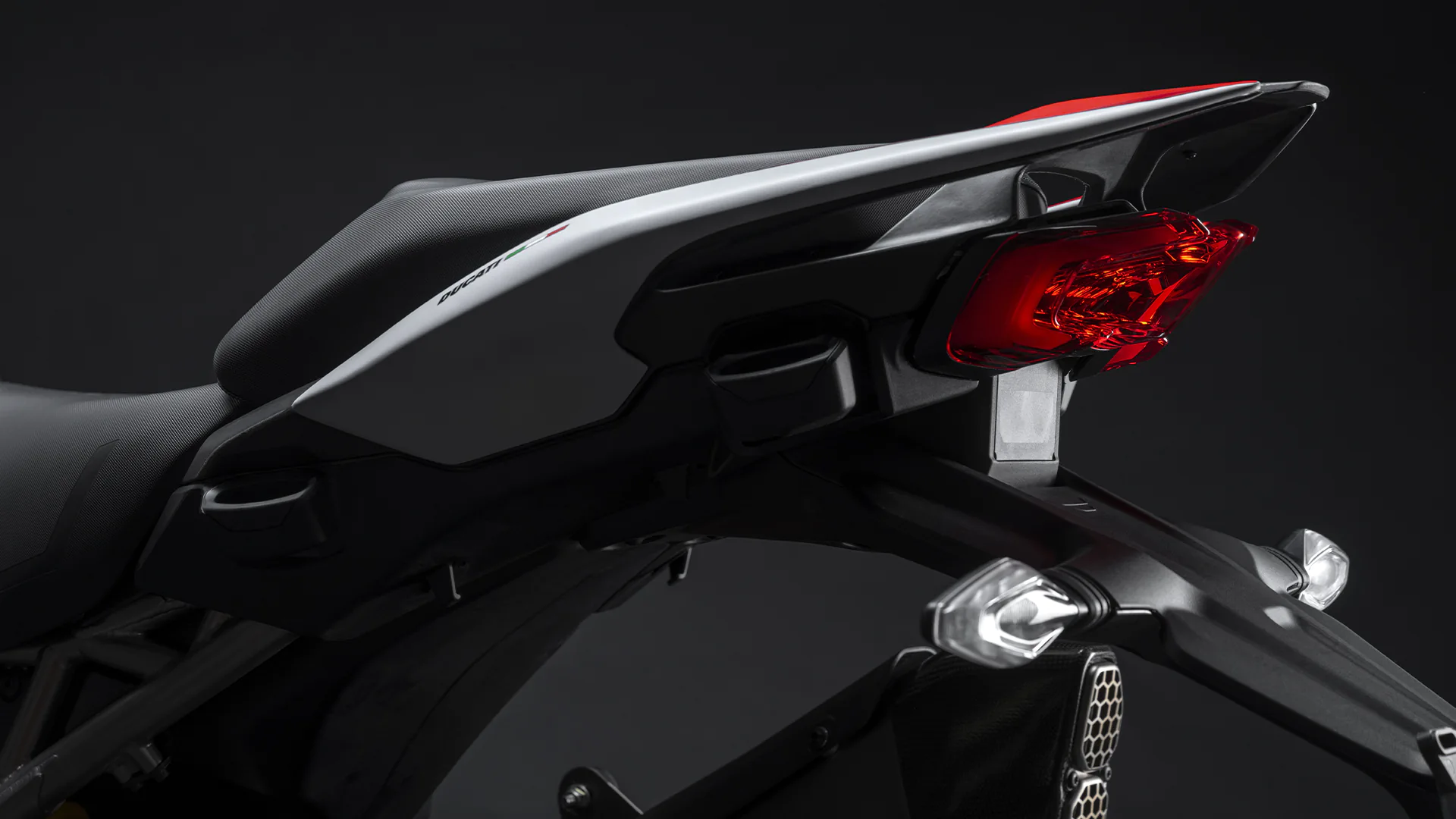
The tail of the Multistrada V4 RS is a combination of lightness and functionality. The seat has several height options (standard 840–860 mm, optionally lower or higher) — this allows you to adjust the ergonomics to the rider's height, which is somewhat similar to the BMW S 1000 XR. Visually, the seat is elongated, with a distinct sporty profile, but it still provides comfort even on long journeys.
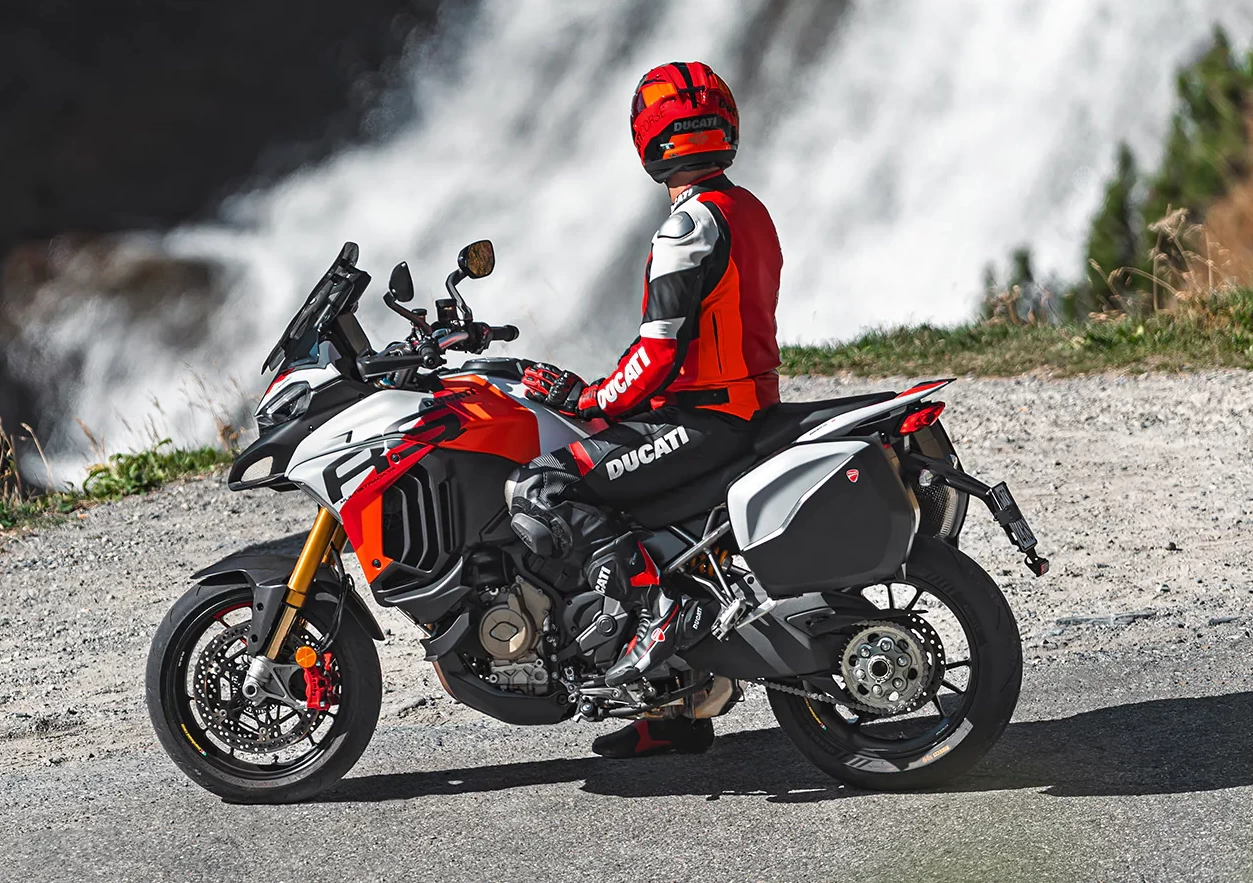
The rear subframe retains its minimalist look but allows for the integration of luggage systems — the panniers do not look out of place but are organically ‘built into’ the design. This is an important point, because the RS has a sporty DNA but should not lose its touring functionality, as it is a touring bike.
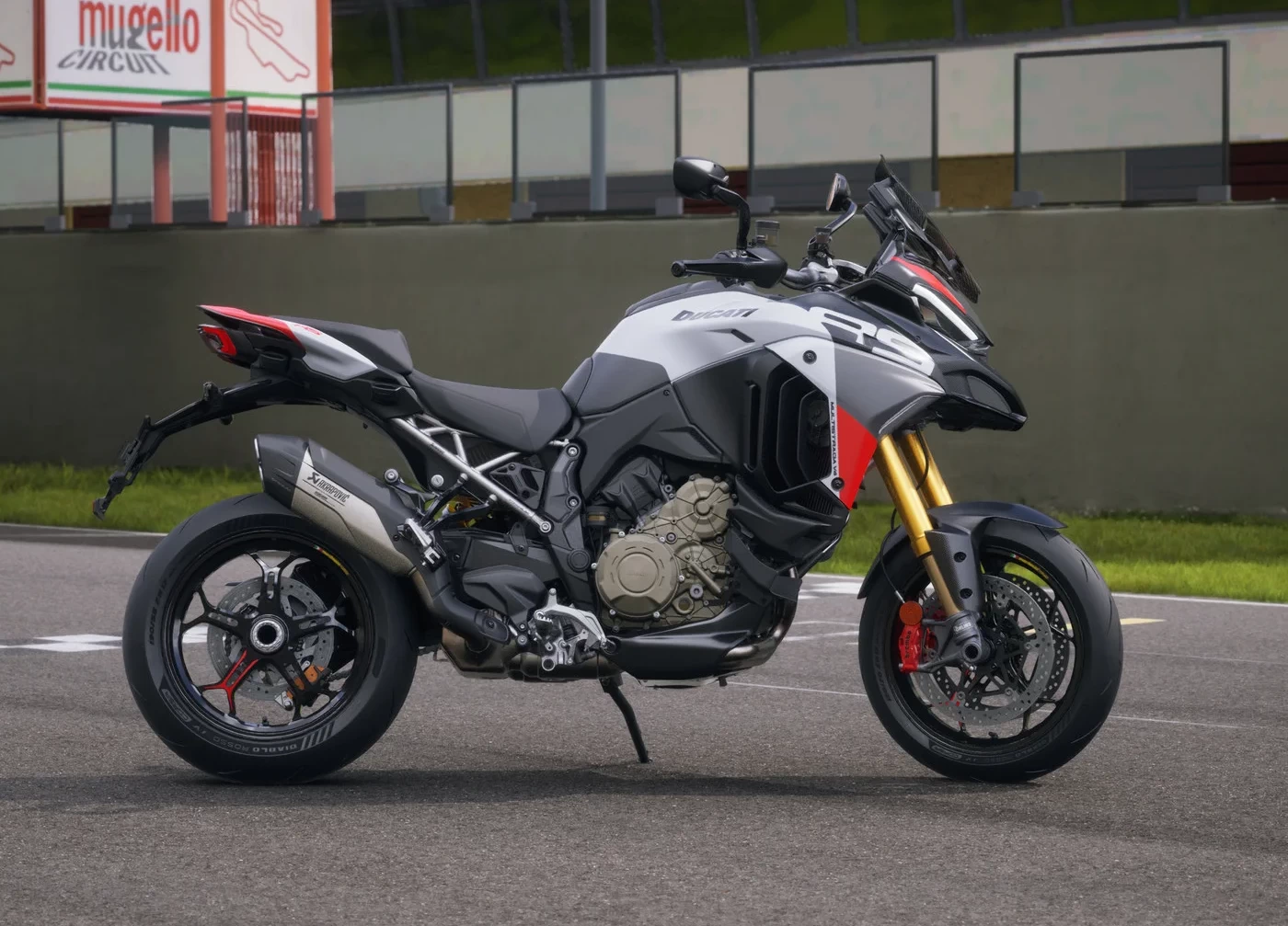
A separate touch is the titanium rear silencer from the M Performance package. Its shape and material emphasise its premium quality, and the sporty sound becomes part of the emotional image. Thanks to the compact geometry of the rear, the tail appears light and compact, emphasising the sporty orientation of the RS.
| Dimension | Value |
|---|---|
| Wet weight no fuel | 225 kg (496 lb) |
| Wheelbase | 1.591 mm (62,6 in) |
| Rake | 25,7° |
| Trail | 120 mm (4,7 in) |
| Fuel Tank Capacity | 22 l (5,8 US gal) |
| Number of Seats | 2 |
CHASSIS and HANDLING
The backbone of the Multistrada V4 RS's sporty performance is its aluminium monocoque frame. It is designed not only to reduce weight but also to ensure maximum rigidity, which is critical at speed. It is this engineering philosophy that makes the RS closer to the Panigale than to classic touring motorcycles.
Suspension
Here, Ducati has gone for the top of the range: electronically controlled Öhlins Smart EC 2.0 suspension. At the front is an inverted Ø48 mm fork, at the rear is a TTX36 shock absorber with electronic preload adjustment. The electronic system scans them in real time: the system analyses acceleration, braking and lean angle and automatically adjusts the stiffness.
The result is noticeable after just a few kilometres: during sharp braking, the front end ‘lifts’ while maintaining horizontal balance, and on high-speed straights, the rear shock absorber ‘removes’ excess vibrations.
Suspension travel is 170 mm at the front and rear. This is more than a classic sports bike, but less than a touring enduro. Thanks to this, the RS retains its versatility for long-distance routes without losing its sporting edge: body roll is minimised and steering response remains as precise as possible.
Contact with the road
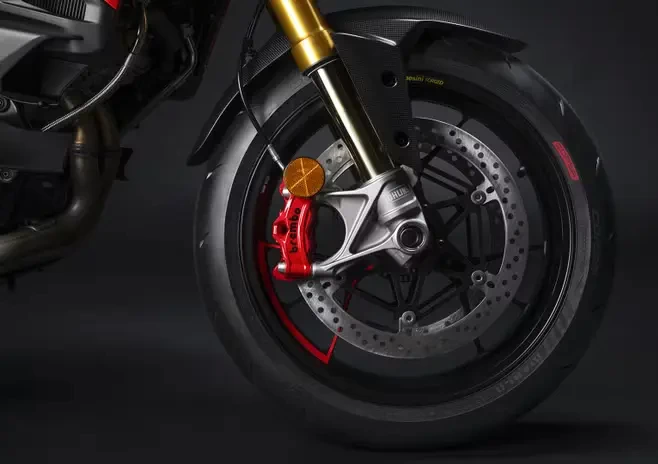
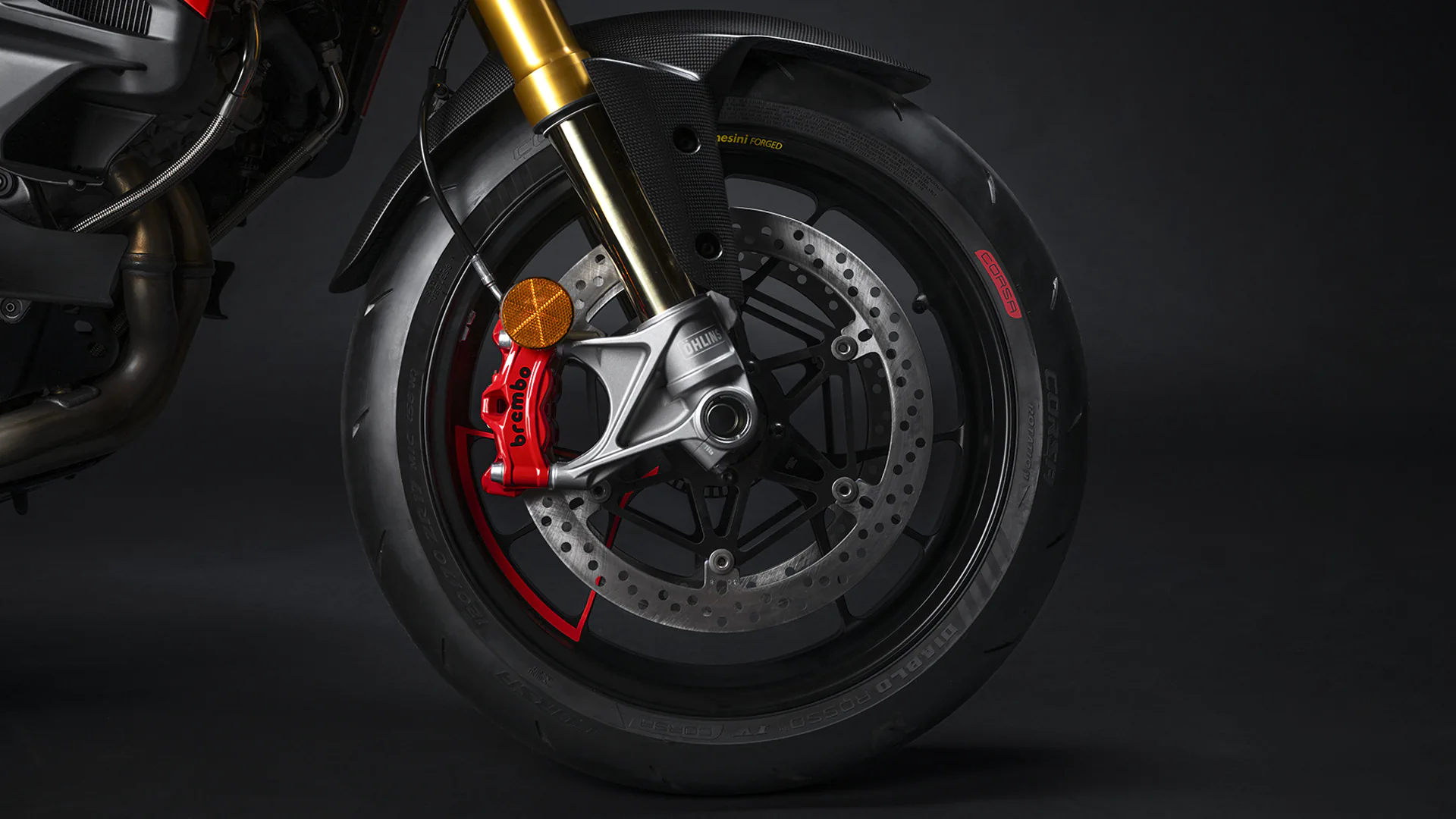
The wheels and brakes play an important role in shaping the appearance of the RS. Ducati used forged Marchesini alloy wheels measuring 3.5‘ × 17’ at the front and 6‘ × 17’ at the rear. The lightness of these wheels gives us faster acceleration, more precise trajectory changes, and less inertia when leaning into turns. This is classic racing technology transferred to the world of sport touring.
The tyres are Pirelli Diablo Rosso IV Corsa. They are designed for the track but optimised for road use. Their profile allows the motorcycle to lean to extreme angles without losing grip. On dry asphalt, they literally ‘bite’ into the surface, giving you the confidence to turn even a mountain serpentine into an improvised track.
The braking system is at a sports level: Brembo Stylema with monoblock calipers and two discs at the front. This is the best in the world of sports bikes — maximum power, minimum weight. Combined with Cornering ABS, the system allows you to brake even when leaning, without the risk of locking up. In practice, even on slippery surfaces, you get bike stability.
| Shassis | Value |
|---|---|
| Frame | Aluminum monocoque frame |
| Front Wheel | Marchesini light alloy forged, 3.5" x 17" |
| Front suspension | Öhlins Ø 48 mm fully adjustable usd fork with TiN treatment, electronic compression and rebound damping adjustment with Öhlins Smart EC 2.0 event-based mode |
| Rear suspension | Öhlins TTX36 fully adjustable shock absorber, electronic compression and rebound damping adjustment with Öhlins Smart EC 2.0 event-based mode, electronic preload adjustment, aluminium single-sided swingarm |
| Rear Wheel | Marchesini light alloy forged, 6" x 17" |
| Rear Tyre | Pirelli Diablo Rosso IV Corsa 190/55 ZR17 |
| Wheel Travel (Front/Rear) | 170 mm / 170 mm (6,7 in / 6,7 in) |
| Front Brake | 2 x Ø 330 mm semi-floating discs, radially mounted Brembo Stylema monobloc 4-piston 2-pad callipers, radial master cylinder, Cornering ABS |
| Rear Brake | Ø 280 mm disc, Brembo 2-piston floating calliper, Cornering ABS |
ELECTRONICS & SAFETY SYSTEMS
The Multistrada V4 RS is a motorcycle where safety and performance merge into a single system. At its core is Bosch Cornering ABS, capable of modulating braking pressure even at deep lean angles. In real-world conditions, even during emergency braking on a serpentine road, you maintain control and stability.
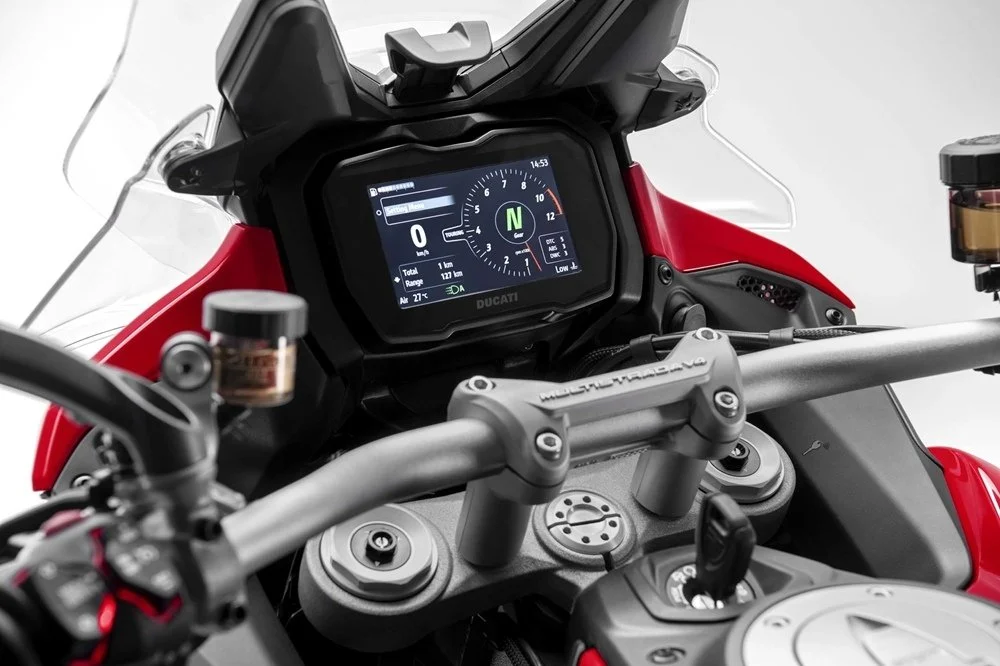
The Ducati Traction Control (DTC), Ducati Wheelie Control (DWC) DVO and Engine Brake Control (EBC) systems are controlled by Ducati Vehicle Observer (DVO). This electronic ‘brain’ analyses speed, lean angle, tyre load and throttle opening, instantly adjusting the engine and suspension. In practice, this is a multi-layered ‘electronic shield’: the wheel does not slip on wet asphalt, the front does not rise excessively during acceleration, and engine braking feels smooth and controlled.
Riding Modes and Power Modes provide additional flexibility. With the push of a button, the rider can transform the RS from a ‘comfortable tourer’ to an almost track-ready sports bike: throttle response, DTC sensitivity and even the ABS algorithm change.
Radar Technology and Adaptability
A key element of the RS's premium safety level is the Radar system with Adaptive Cruise Control. This is the same technology we are used to seeing in premium cars. The front radar tracks the traffic ahead and automatically adjusts the speed, maintaining the set distance. In practice, you won't feel tired even after hundreds of kilometres on the motorway.
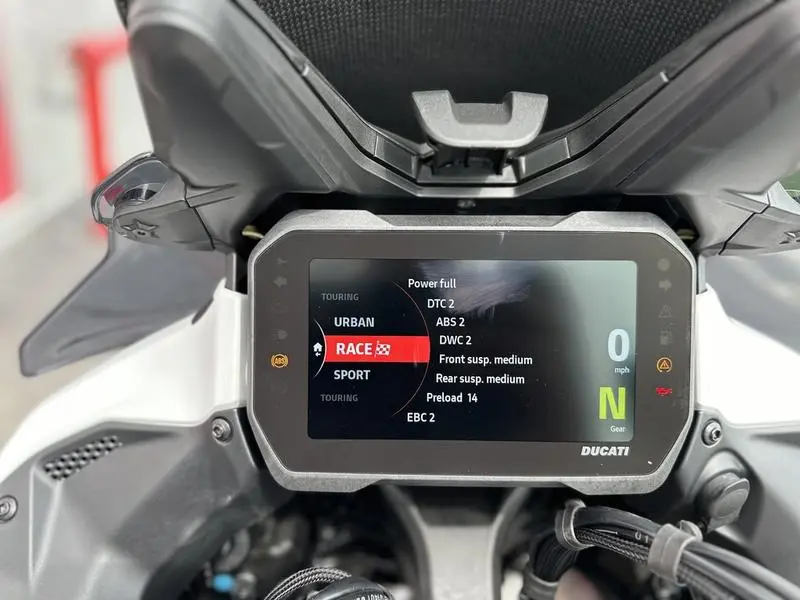
Another important element is Öhlins Smart EC 2.0, which is integrated into Ducati Electronic Suspension (DES) 2.0. The suspension here works not only for performance (reducing roll, stability in corners), but also as a safety system: it instantly adapts to road conditions and load, preventing uncontrolled swaying or excessive sagging when braking.
Ergonomics and Comfort
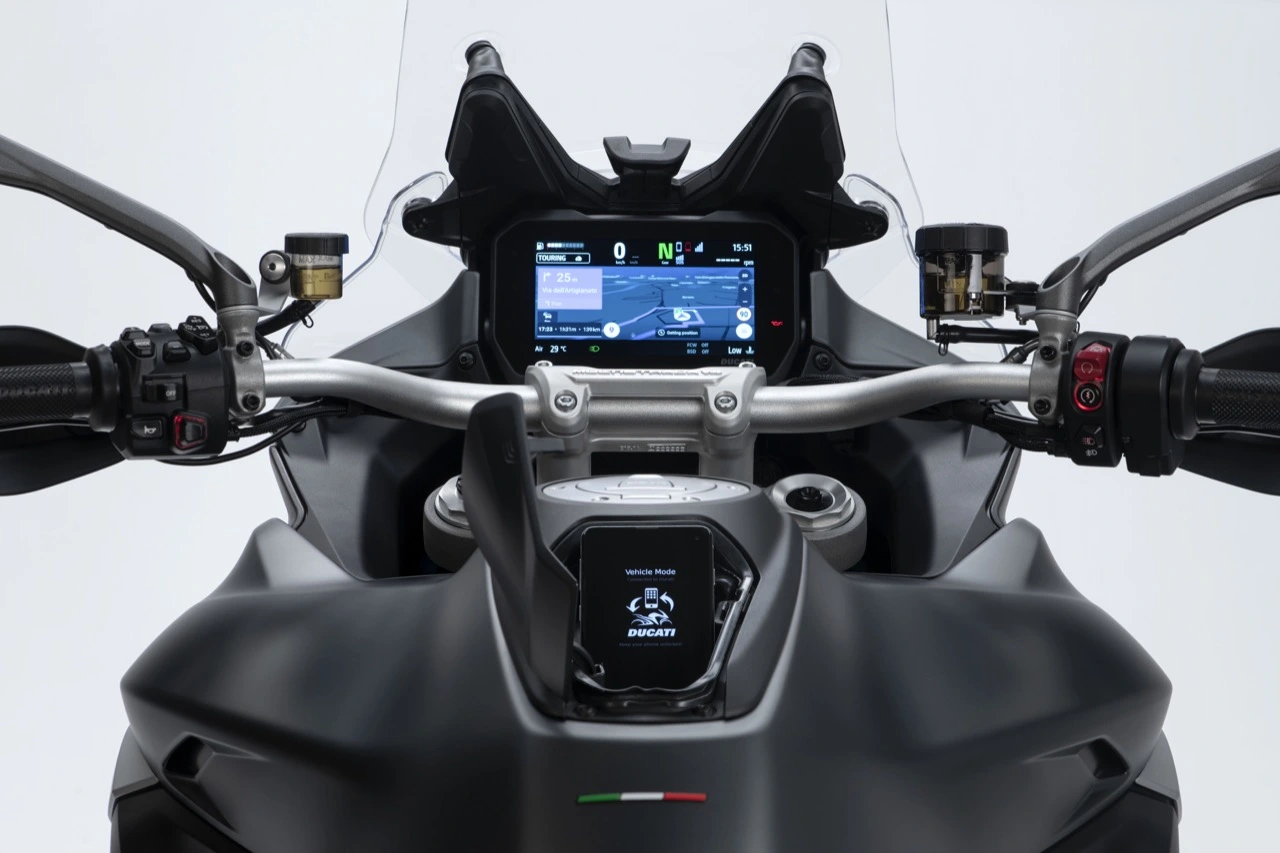
The centrepiece is a 6.5-inch TFT display with Ducati Connect and full-map navigation. Thanks to the high resolution and logical menu structure, you can access all telemetry and route information without distracting you from the road.
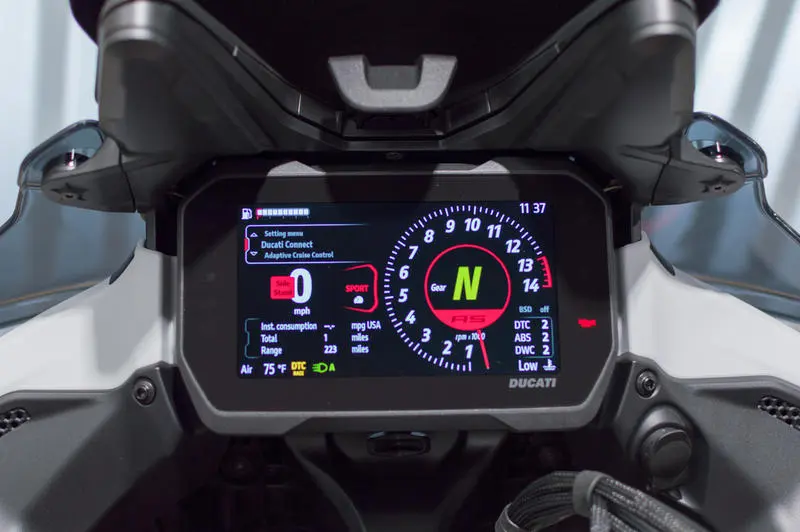
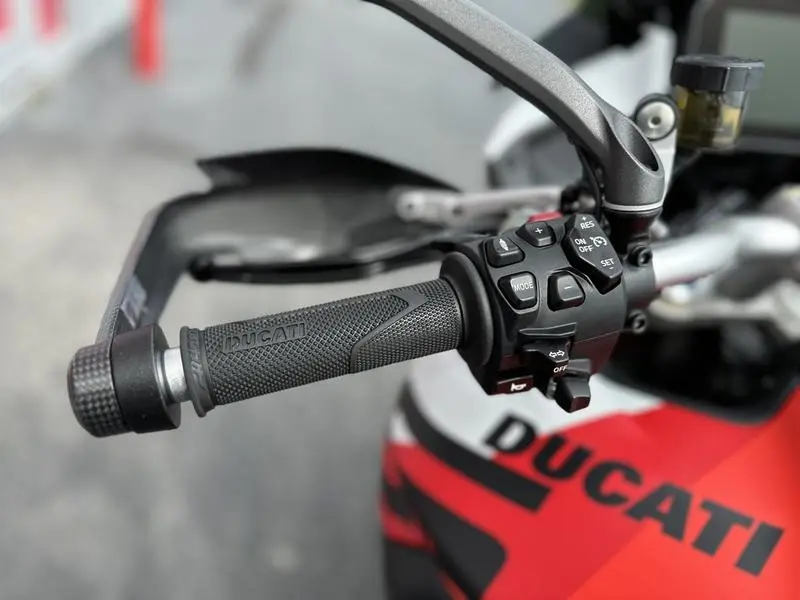
Standard equipment includes a hands-free system, keyless fuel cap, heated grips and illuminated switches. These are the little things that make everyday comfort: no need to search for keys, your hands stay warm in cold weather, and night-time riding becomes intuitively simple.
The Ducati Quick Shift 2.0 system allows you to shift up and down without the clutch. The Akrapovič titanium silencer only adds to the feeling of sporting DNA.
Passive safety systems are complemented by TPMS (tyre pressure monitoring) and additional LED lighting. TPMS warns of pressure loss before it becomes dangerous, and additional LEDs ensure maximum visibility in the dark and in the rain.
ENGINE SPECIFICATIONS & TRANSMISSION SYSTEM
At the heart of the Multistrada V4 RS is the Desmosedici Stradale V4, the same engine borrowed from the Panigale and adapted for a ‘hybrid’ sport-touring role. The 90° V4 architecture, with four valves per cylinder and a semi-dry sump, creates a compactness and balance that is almost impossible to achieve in inline fours.
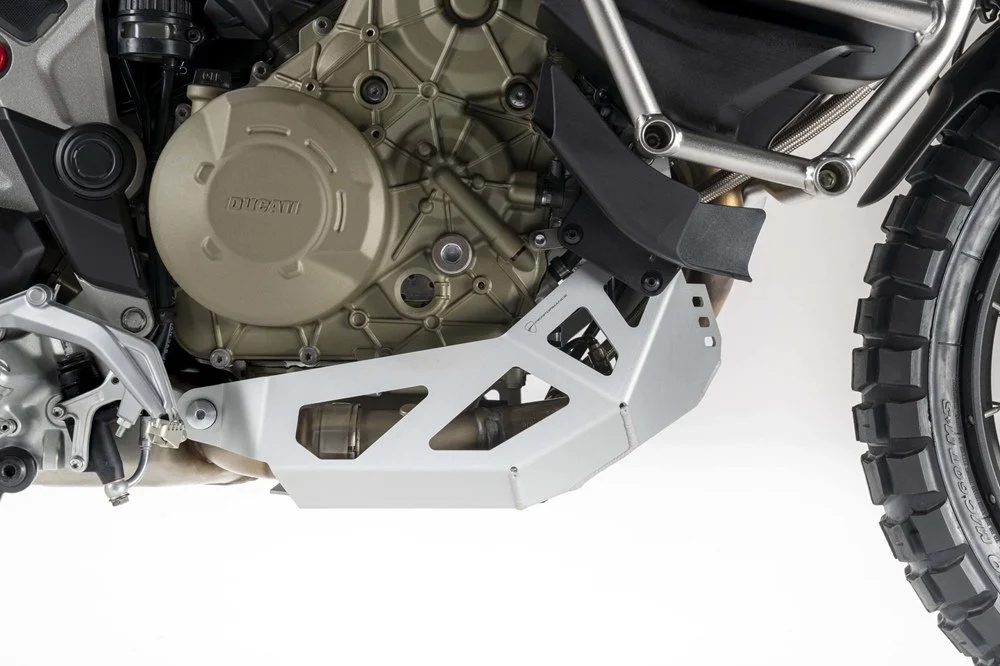
The key element is the counter-rotating crankshaft. This is a crankshaft that rotates in the opposite direction to the wheels. This engineering compensates for the gyroscopic effect, makes it easier to turn the motorcycle and makes handling easy, despite the kerb weight of a touring enduro.
The engine displacement is 1103 cm³, with a bore x stroke ratio of 81 mm × 53.5 mm. This is an ‘oversquare’ configuration: the short piston stroke makes it easy to reach high revs, and the large cylinder diameter provides space for large valves. The result is maximum power for the tourist.
With a compression ratio of 14.0:1 and a unique twin pulse firing order, the V4 RS delivers 180 hp at 12,250 rpm and 118 Nm at 9,500 rpm. The power curve speaks for itself: the engine pulls briskly from mid-range, but the real ‘explosion’ is felt after 8,000 rpm — the character of the Panigale, integrated into the Multistrada platform, comes to the fore.
Fuel and Exhaust System
Fuel is supplied by an electronic injection system with equivalent oval throttle valves (Ø50 mm) controlled by the Ride-by-Wire system. This solution not only allows for perfect throttle control, but also shapes the engine's character depending on the selected Riding Mode. In Touring mode, the throttle is soft and smooth, while in Sport mode it is sharp and aggressive, ready for track attacks.
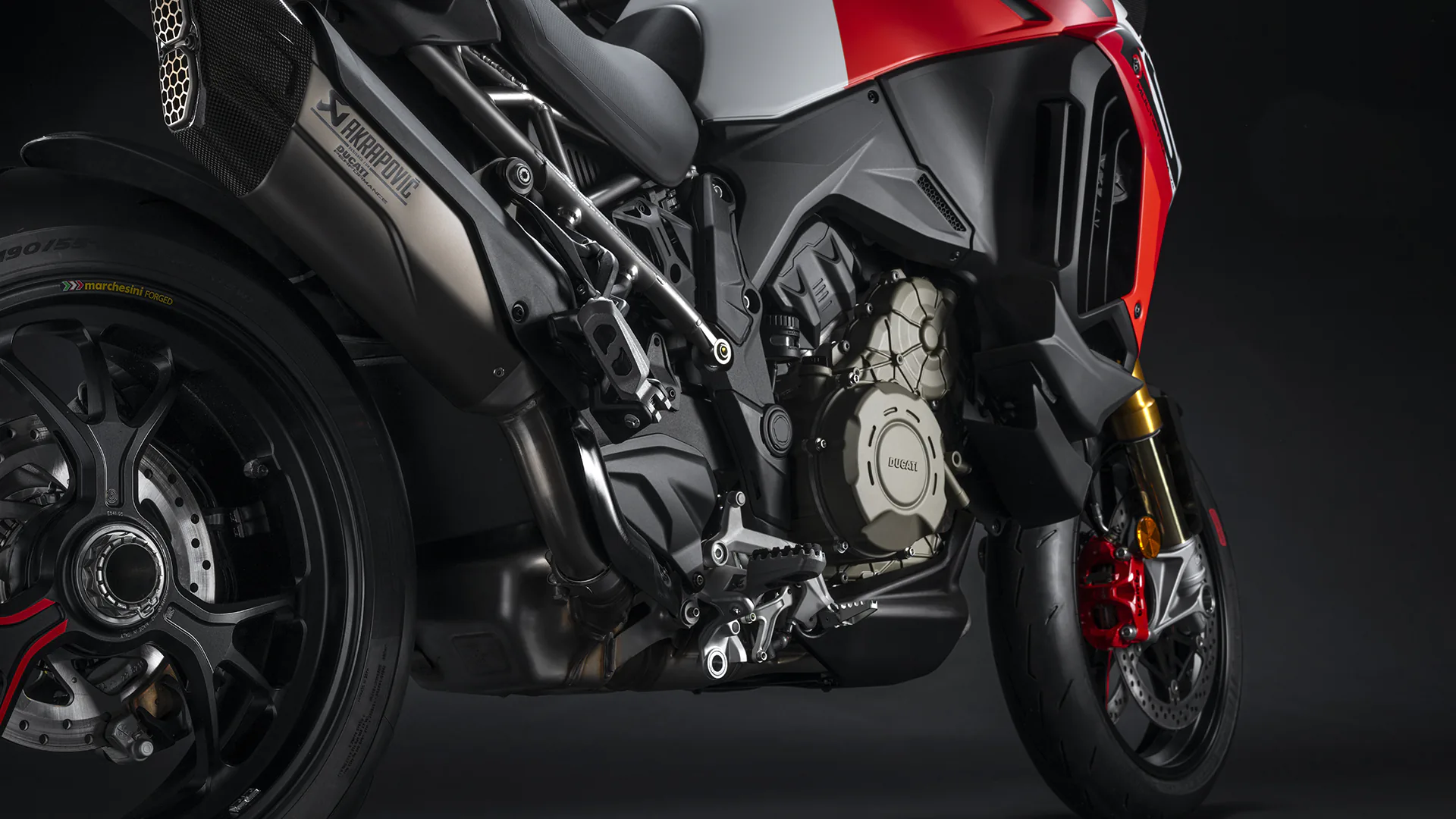
The RS exhaust system deserves special attention. The standard stainless steel press-fit silencer is combined with a titanium Akrapovič silencer certified for road use. This not only reduces the overall weight by a few kilograms, but also provides unique acoustics. The dry, metallic tone of the Desmosedici combined with Akrapovič turns every throttle opening into an emotional explosion — a characteristic feature of the RS that emphasises its sporty heart in the body of a tourist.
Transmission
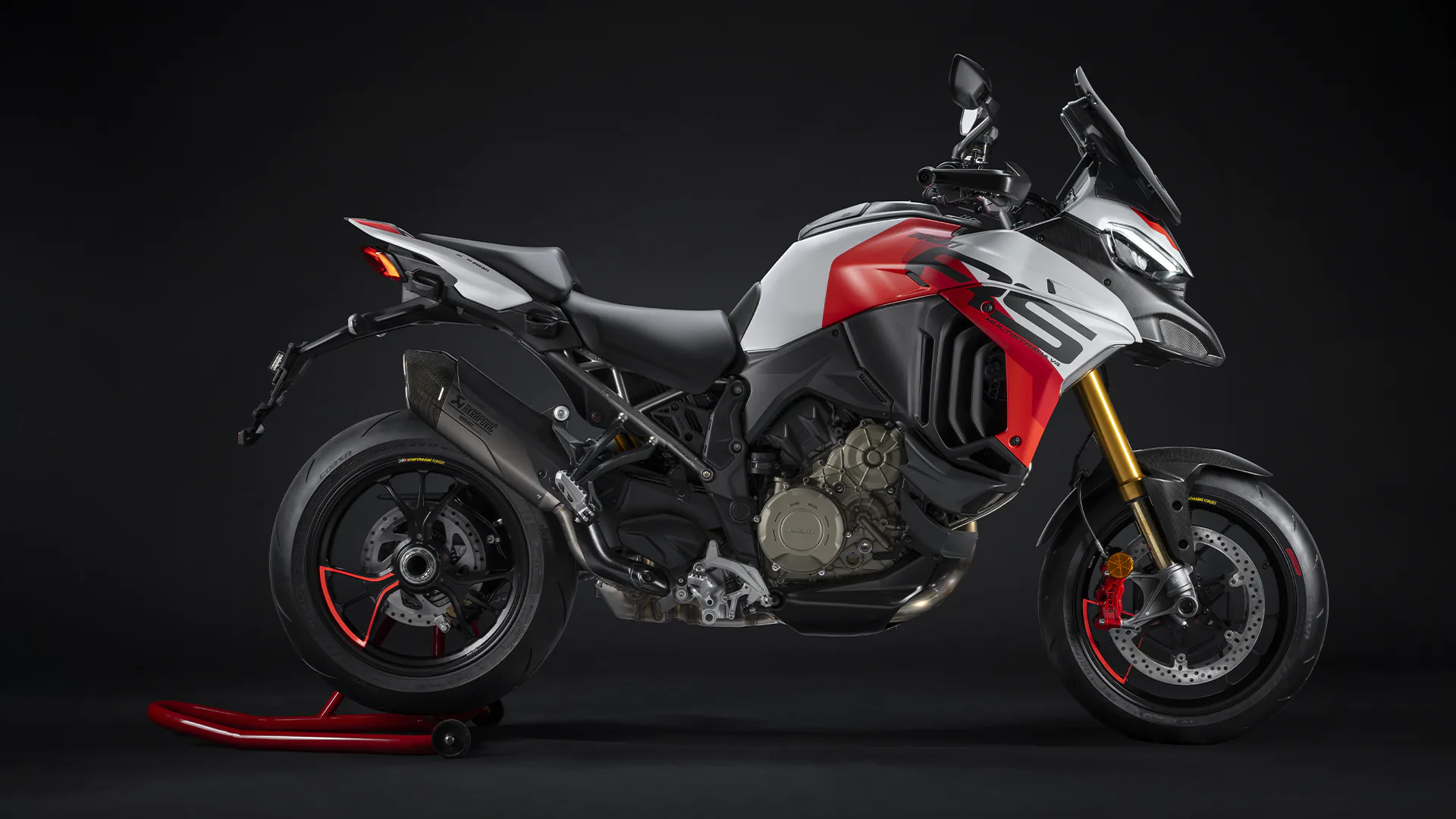
The V4's power is transmitted through a 6-speed gearbox equipped with Ducati Quick Shift (DQS) 2.0. This is a bidirectional quick shifter that allows you to shift up and down without using the clutch. For the rider, this means continuous acceleration, perfect gear feel and no need to disengage the clutch even during aggressive braking.
But the real symbol of the RS is the Multiplate dry clutch with slipper function. This is Ducati's classic solution for top sports models, offering several advantages:
- Acoustics: characteristic ‘ringing’ sound — RS's calling card.
- Performance: dry clutch dissipates heat better.
- Slipper action: when shifting down, the system automatically reduces rear wheel lockup, making engine braking controlled and smooth.
| Engine Feature | Specification |
|---|---|
| Engine Type | Ducati Desmosedici stradale, V4 - 90°, 4 valves per cylinder, counter-rotating crankshaft, twin pulse firing order, semi dry sump, liqued cooled |
| Displacement | 1.103 cc (67,3 cu in) |
| Bore x Stroke | 81 mm / 53,5 mm (3,2 in / 2,1 in) |
| Compression Ratio | 14,0:1 |
| Power | 180 hp (132,4 kW) @ 12.250 rpm |
| Fuel Injection | Electronic fuel injection system, Øeq 50mm equivalent elliptical throttle bodies with Ride-by-Wire system |
| Exhaust | Stainless steel pre-silencer, Akrapovič titanium muffler |
| Gearbox | 6 speed with Ducati Quick Shift up/down 2.0 |
| Primary drive | Straight cut gears; Ratio 1.8:1 |
| Ratio | 1=40/13, 2=36/16, 3=34/19, 4=31/21, 5=29/23, 6=27/25 |
| Final drive | Chain, Front sprocket Z15; Rear sprocket Z43 |
| Clutch | Multiplate dry clutch with slipper action on over-run |
RIDING IMPRESSIONS
I still remember the moment when I pressed the starter button. The Desmosedici Stradale V4 came to life, and the air filled with a distinctive tone — deep, metallic, with that same dry clutch sound that instantly makes it clear: this is not just a touring enduro, but a real sports bike in the guise of a Multistrada touring bike. It's a sound that cannot be mistaken — it's aggressive, a little ‘rough’, but that's exactly what makes it so charming: it warns you that the RS demands respect.
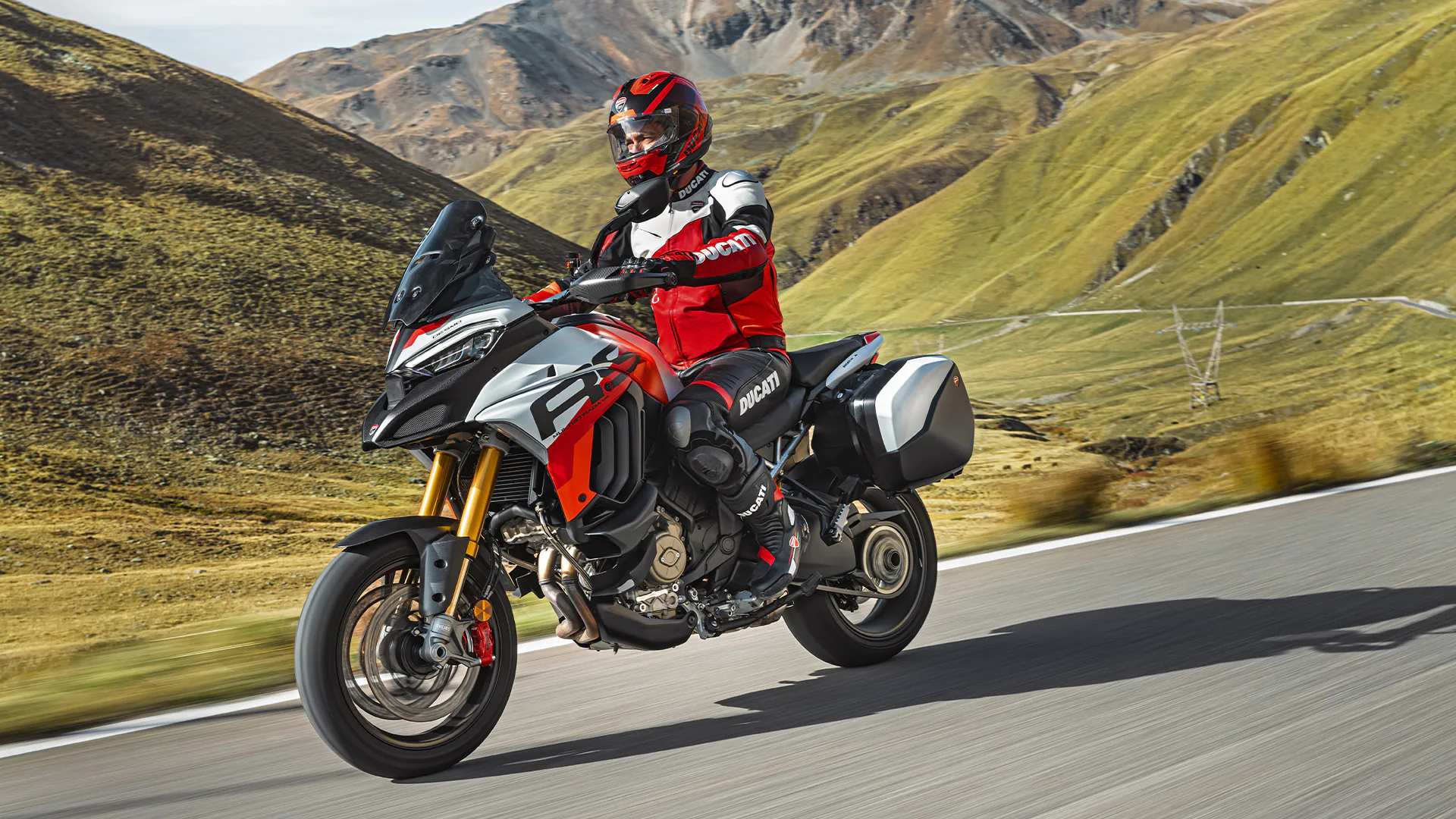
The seating position was surprising. You sit high up and can see everything around you, just like on a classic Multistrada, but thanks to the narrow tank and clever ergonomics, I immediately felt in control of the bike. It's not a closed-off riding position, but a comfortable, versatile geometry that allows you to spend the day in the saddle while still leaving room for aggressive body movements.
The V4 comes alive from low revs, but the real magic begins after 7-8 thousand revolutions. In Touring mode, the engine is smooth, the torque unfolds smoothly, and you can calmly conquer hundreds of kilometres. In Race mode, everything changes — the throttle response becomes almost instantaneous, and the bike surges forward so that every quick shifter shift feels like a shot. 180 hp at peak is not just a number, it's an adrenaline rush that literally blurs the line between a sports bike and a touring enduro.
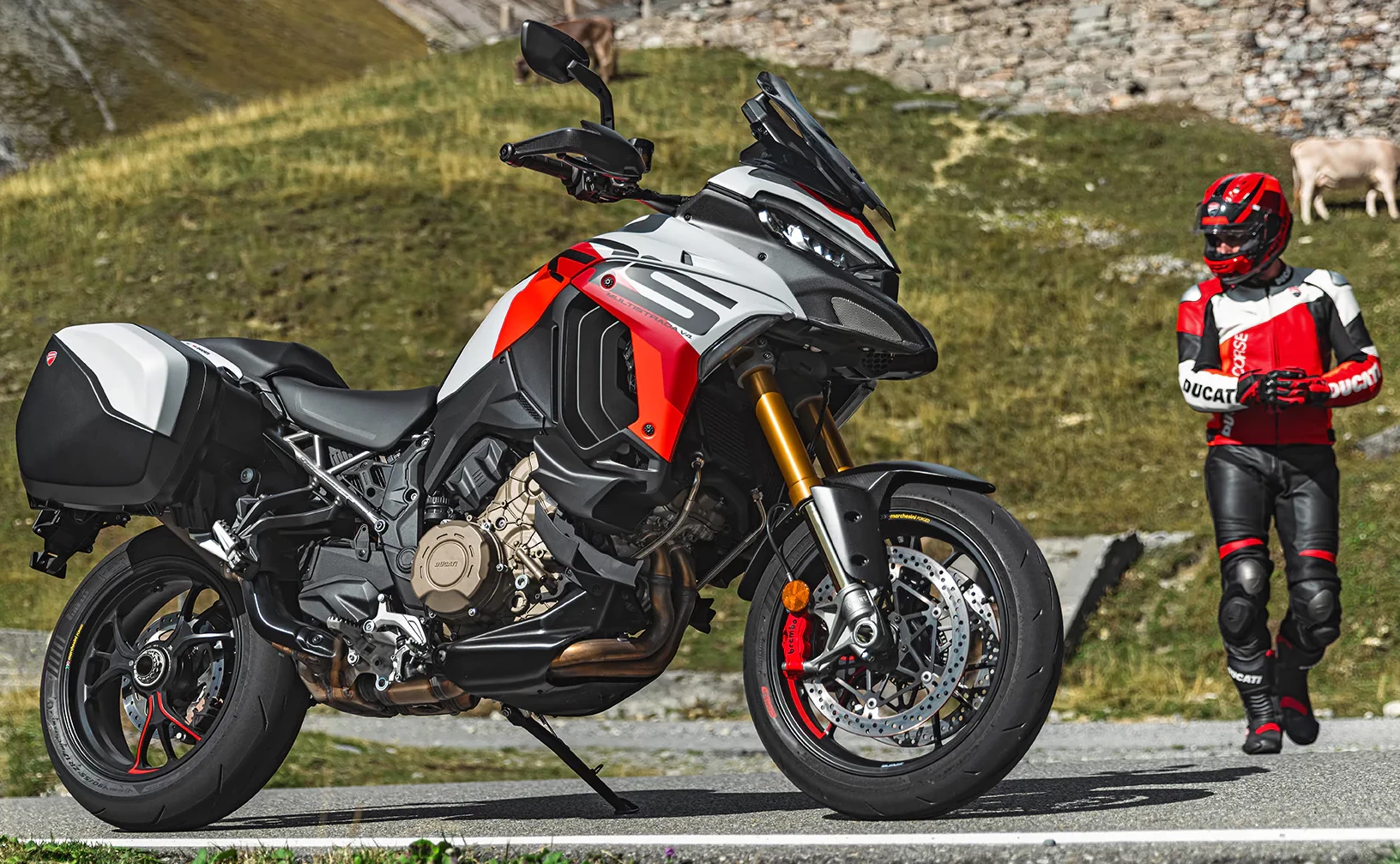
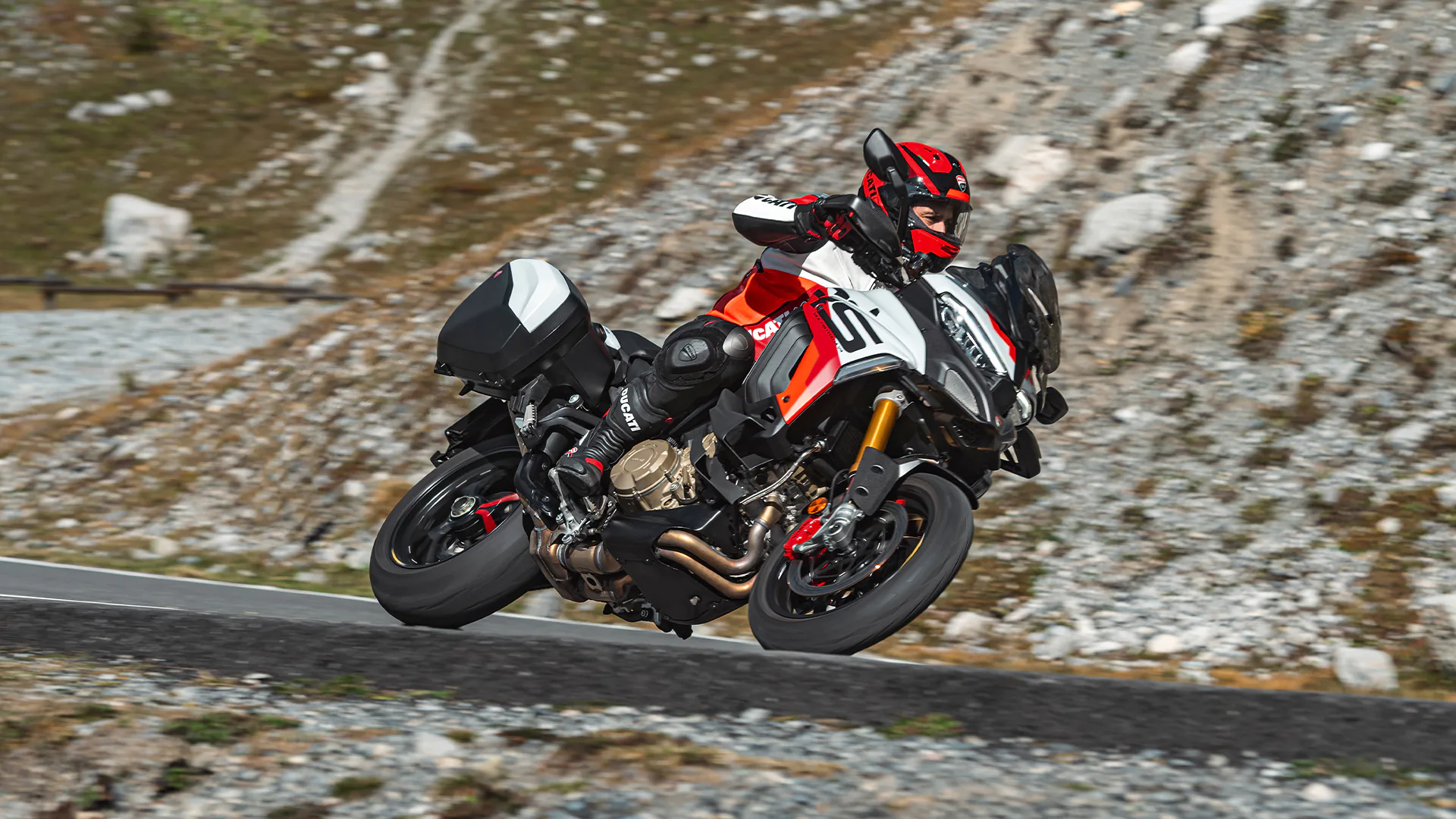
Another thing that impressed me was the Öhlins Smart EC 2.0. In city traffic, the suspension behaves delicately, smoothing out bumps, but as soon as you enter the serpentines, everything changes. The shock absorbers ‘lift’ the bike, minimising body roll, and suddenly the 225 kg seems much lighter. It feels as if the Multistrada is looking at the road with you.
The RS is impressively light in corners. Forged Marchesini wheels and sports tyres make it surprisingly manoeuvrable: you can shift the bike from lean to lean with a single movement, and it responds without delay. Brembo Stylema brakes give you a feeling of absolute control — you press, and the bike stops with perfect precision.
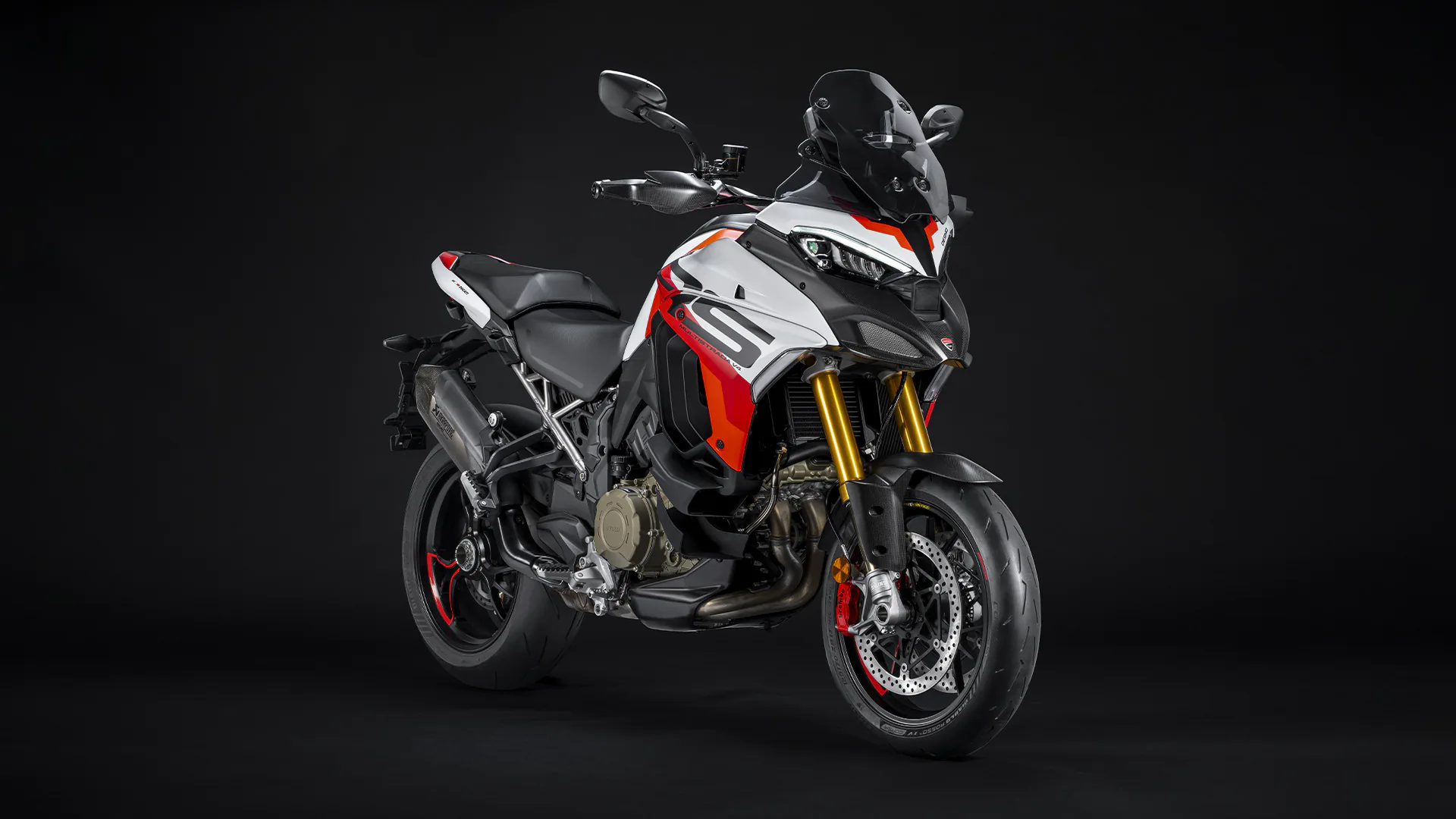
The Ducati Multistrada V4 RS (2025) is a paradox in the best sense of the word: a comfortable touring bike that sounds and behaves like a Panigale. And when the dry clutch chimes at idle, you realise that this machine is designed to make every ride a memorable one.
FUEL CONSUMPTION
City
In urban conditions, the Multistrada V4 RS performs quite predictably, but the sporty nature of the engine does its job. Frequent starts from traffic lights, driving in traffic jams and active use of Quick Shift 2.0 keep fuel consumption at 7.5–8.5 l/100 km. The Desmosedici Stradale V4 with a short piston stroke loves revs, so even in Urban mode (with limited power output) it is difficult to resist sudden throttle openings. At the same time, the electronics help to smooth out the sharpness, but you should not expect miracles in the city from 1103 cubic centimetres.
Highway
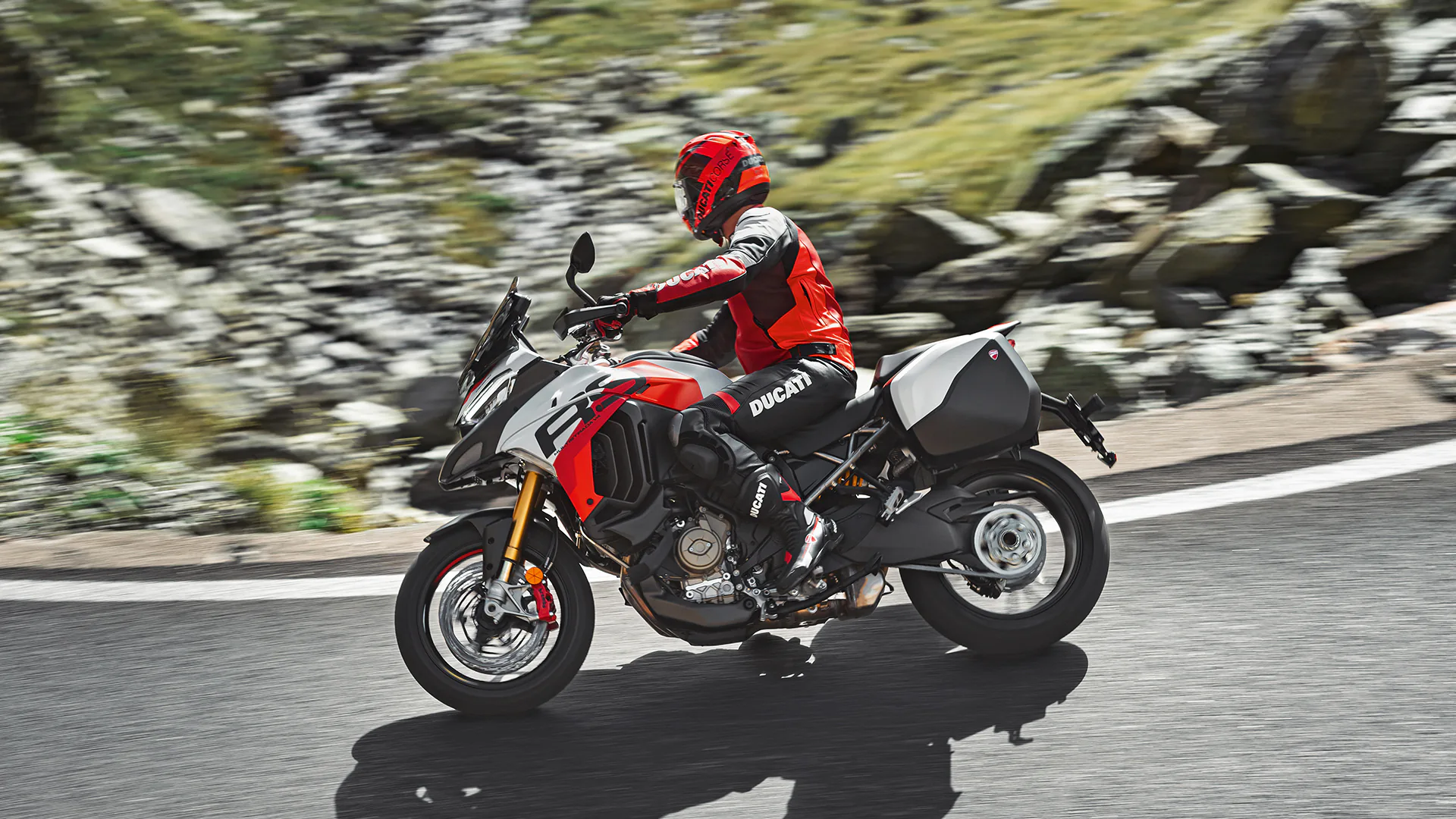
The RS surprises with its efficiency on the highway. At a steady cruising speed of 110–120 km/h and with adaptive cruise control activated, fuel consumption remains stable at 5.8–6.5 l/100 km. This is thanks to the aerodynamics of the fairings and the stability of the V4, which ‘breathes’ calmly at medium revs without excessive appetite. In this mode, the Multistrada feels like a touring bike: measured, predictable and surprisingly economical for its power.
Mixed Cycle
The most representative scenario for the V4 RS is a combination of city and country roads. Here, the average figure fluctuates between 6.5 and 7.2 litres per 100 kilometres. It all depends on how much of the route you drive at a ‘tourist’ pace and how much you drive aggressively. The 180 hp engine responds instantly to any movement of the wrist, so the mixed cycle is always a compromise between economy and the desire to hear the V4 roar after 8,000 rpm.
Countryside / Active Riding
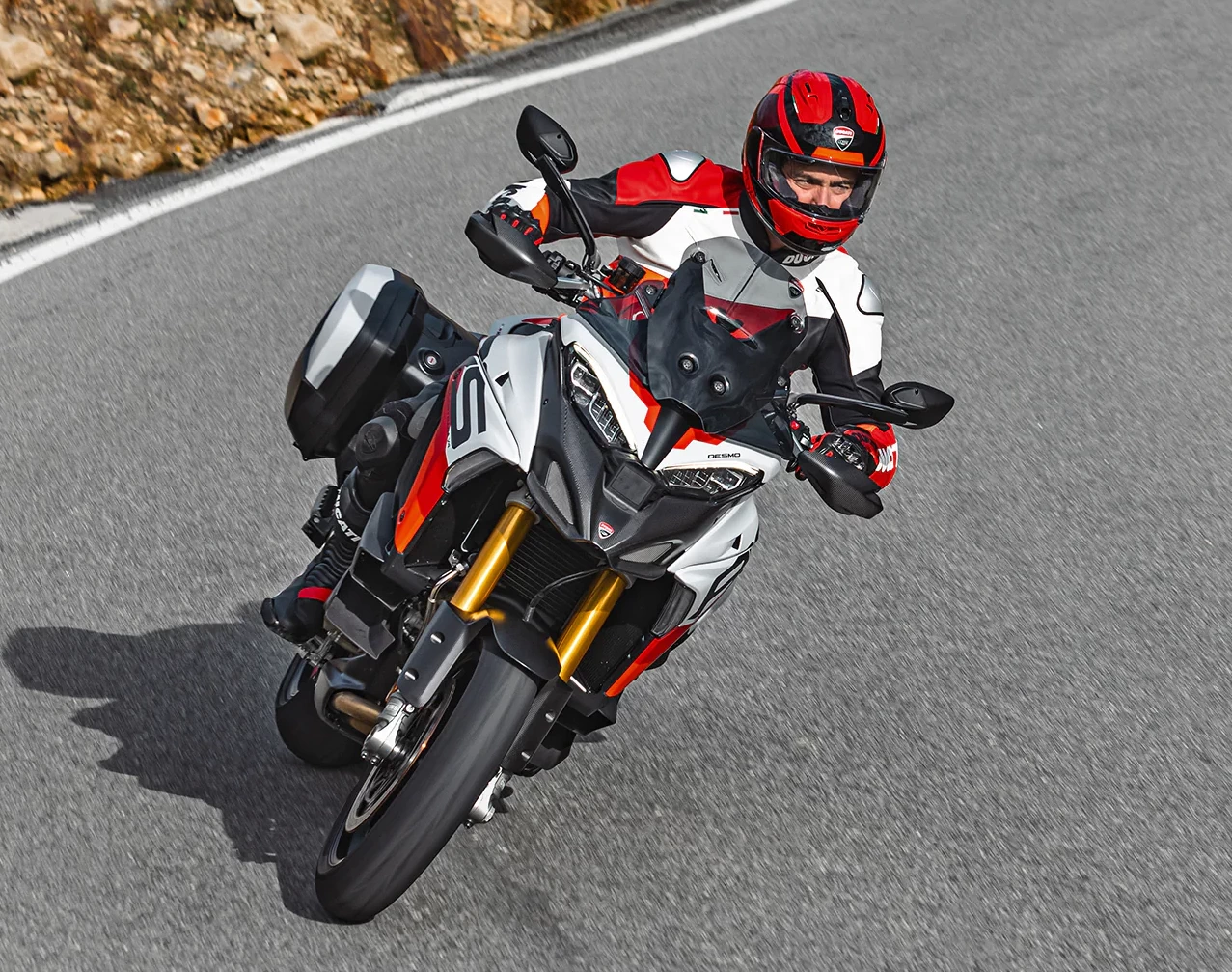
This is where the RS reveals its true character. Serpentine roads, frequent acceleration and braking, constant work with the body — and you get fuel consumption of 8.5–9.5+ l/100 km. This is a direct result of the aggressive Race mode, the throttle wide open and the dry clutch working in tandem with the quick shifter. In these conditions, the Desmosedici Stradale V4 burns fuel as fast as it gives you adrenaline, and every litre feels justified.
PRICING
The Multistrada V4 RS 2025 is the top of the range, and the price immediately signals its exclusivity. The base price starts at around $35,000 (in EU markets), and the figure itself is explained by the technical specifications. At its heart is a Desmosedici Stradale V4 engine with dry clutch, borrowed from the Panigale, Öhlins Smart EC 2.0 suspension with electronic control, and Marchesini forged wheels. These are components that we usually only see on track superbikes, and they are what set the high entry threshold.
But the real ‘cost’ begins when the owner customises the RS to suit their needs. If you are planning long journeys, a set of side cases and a top case will easily add a few thousand euros, but will turn the motorcycle into a true grand tourer. For everyday comfort, consider heated grips, a comfortable seat and additional LED lights — small details that make a difference on a cold road or at night. Fans of sporty aesthetics and minimal weight choose carbon fibre elements and protective accessories, giving the RS an even more distinctive racing look. Finally, electronic options such as alarms or GPS trackers not only affect safety but also the owner's peace of mind — and they also raise the price.
Thus, the final amount can reach $40,000+, but every extra euro is justified here: it either enhances ergonomics or reveals the sporting soul of the RS, adapting the motorcycle to the style of a particular rider.
CONCLUSION
Ducati decided to raise the stakes in the world of sports touring and released the Multistrada V4 RS 2025. This is not just another ‘adventure’ bike, but actually a sports bike in a touring body. And yes, it makes its competitors — the BMW S 1000 XR, KTM 1290 Super Adventure S and Triumph Tiger 1200 GT Explorer — scratch their heads. But let's figure out where it really excels and where it compromises.
Engine and Transmission
The heart of the V4 RS is the legendary V4 Desmosedici Stradale from Panigale. It delivers 180 hp at 13,500 rpm and has a dry clutch. If you like the characteristic ‘metallic’ sound and precision torque delivery, this is pure music. The bike accelerates to 100 km/h in less than 3 seconds, which is already in the realm of sports bikes.
Now for the competition: the BMW S 1000 XR, with its 165 hp, is more predictable and consistent. The KTM 1290 Super Adventure S (160 hp, 138 Nm) pulls harder and is more comfortable at low revs. The Triumph Tiger 1200 GT Explorer (150 hp, 130 Nm) feels the most relaxed and ‘touring’ of the four competitors.
Chassis and Handling
Ducati has focused on sport: Öhlins Smart EC 2.0, forged wheels, carbon fibre parts. The bike is lighter, stiffer and more precise in corners than its competitors. BMW is more comfortable and friendly to different scenarios in this regard. KTM is the champion in terms of ground clearance and off-road capabilities. Triumph is the true king of motorways: massive, calm and stable over long distances.
Electronics and Safety
Ducati offers a comprehensive package: cornering ABS, traction control, adaptive cruise control with radar, and Blind Spot Detection. The premium feel is evident here — everything works seamlessly and emphasises the sporty character. BMW has a similar package, but without radar systems. KTM stands out with its intuitive travel modes. Triumph focuses on simplicity and trust — fewer ‘toys’ and more comfort.
Price and fuel consumption
This is where Ducati's disadvantages begin. At $35,000, it is the most expensive of the three. By comparison, the BMW starts at $22,000, the KTM at $23,500, and the Triumph at $21,000. This is a significant difference. As for consumption, the V4 RS consumes 6.5–7.0 l/100 km, while BMW stays at 5.8–6.2, KTM at 6.0–6.5, and Triumph at 5.5–6.0. Add to this the more expensive maintenance of Ducati.
✅Ducati V4 RS:
- Insane power: 180 hp and acceleration <3 seconds.
- Sporty features: dry clutch, Öhlins, carbon fibre.
- The most exciting handling in its class.
- Maximum set of electronic safety systems.
❌Ducati V4 RS:
- The highest price in the segment.
- Off-road capabilities are inferior to KTM.
- Fuel consumption and maintenance are expensive.
- Less convenient for pure tourism (loses to Triumph).
Competitors in a nutshell
- BMW S 1000 XR — versatile balance for a more reasonable price.
- KTM 1290 Super Adventure S — off-road and powerful at low revs.
- Triumph Tiger 1200 GT Explorer — comfort and range, without racing.
The Ducati Multistrada V4 RS is a bike for those who want maximum adrenaline in a sport-touring format. If exclusivity, speed and premium components are important to you, and you are willing to pay not only for the motorcycle itself but also for its maintenance, this is the ideal option.
But if you are looking for practicality, comfort over long distances or more off-road orientation, BMW, KTM or Triumph would be more logical and cheaper choices.
Ducati Multistrada V4 RS 2025 Service FAQ
1. What is the Desmo service interval for the Desmosedici V4 RS engine?
The Desmosedici Stradale V4 in the RS version has the longest valve inspection interval in Ducati history — 60,000 km. Intermediate maintenance is performed every 15,000 km or once a year, whichever comes first.2. What engine oil is recommended for the Multistrada V4 RS?
Ducati officially recommends Shell Advance 4T Ultra 15W-50, a fully synthetic oil with PurePlus technology. Its thermal stability is particularly important for the V4, which operates at temperatures above 110 °C in urban conditions. The oil system capacity is 4.1 litres (including the filter). Replacement is performed every 15,000 km or annually.3. How to maintain a dry clutch on a V4 RS?
It does not come into contact with oil, so it requires regular visual inspection through the ventilation window and cleaning of dust from the friction discs. Depending on the riding style, the service life of the kit is from 12,000 to 25,000 km. For track or aggressive use, it is recommended to check the condition of the discs after every 5,000 km.4. How often should the transmission chain be serviced?
Lubrication — every 600–800 km or after every ride in the rain. Check the tension every 1,000 km. Ducati recommends keeping the slack within 30–35 mm. For the 180 hp RS, this is critical: incorrect tension can lead to accelerated wear on the sprockets.5. Does the Öhlins Smart EC 2.0 electronic suspension need to be calibrated?
The Smart EC 2.0 system is adaptive and self-calibrates to the specific rider, weight and riding style. However, Ducati recommends checking the calibration and updating the software every 15,000 km or after installing a new software profile (Track, Sport, Touring mode). The work is performed only through the official DDS 3.0 diagnostic interface.6. How often should Brembo Stylema brake fluid and pads be replaced?
For Brembo Stylema calipers, it is recommended to use DOT 4 Racing grade fluid, replacing it every 24 months. Pads should be checked every 5,000 km, or sooner if the friction layer thickness is reduced to 1 mm.7. What is included in the first (zero) service after 1,000 km?
The first service for the Multistrada V4 RS is mandatory and includes: replacement of engine oil and oil filter; checking the tightening torques of all major components (frame, swingarm, brakes); updating the software of electronic modules (ECU, suspension, IMU); diagnostics of the Öhlins EC 2.0 system; checking the chain tension and coolant level.8. Will the warranty be void if I perform maintenance myself?
Ducati allows owners to perform basic maintenance: chain lubrication, tyre pressure checks, coolant refills. However, all operations related to the engine, clutch, electronics or Öhlins system must be performed only at a certified Ducati centre. Otherwise, the warranty on the power unit and electronic systems will be void.
Ducati Multistrada V4 RS Video Review


JoomShopping Download & Support